What you will learn
- Locate the pale clay in relation to the body and the glaze.
- Trace the green space ahead of a bird as carefully as the bird itself.
- Compare what a side view of the bowl reveals with a view from above.
A narrow mouth and broad shoulders
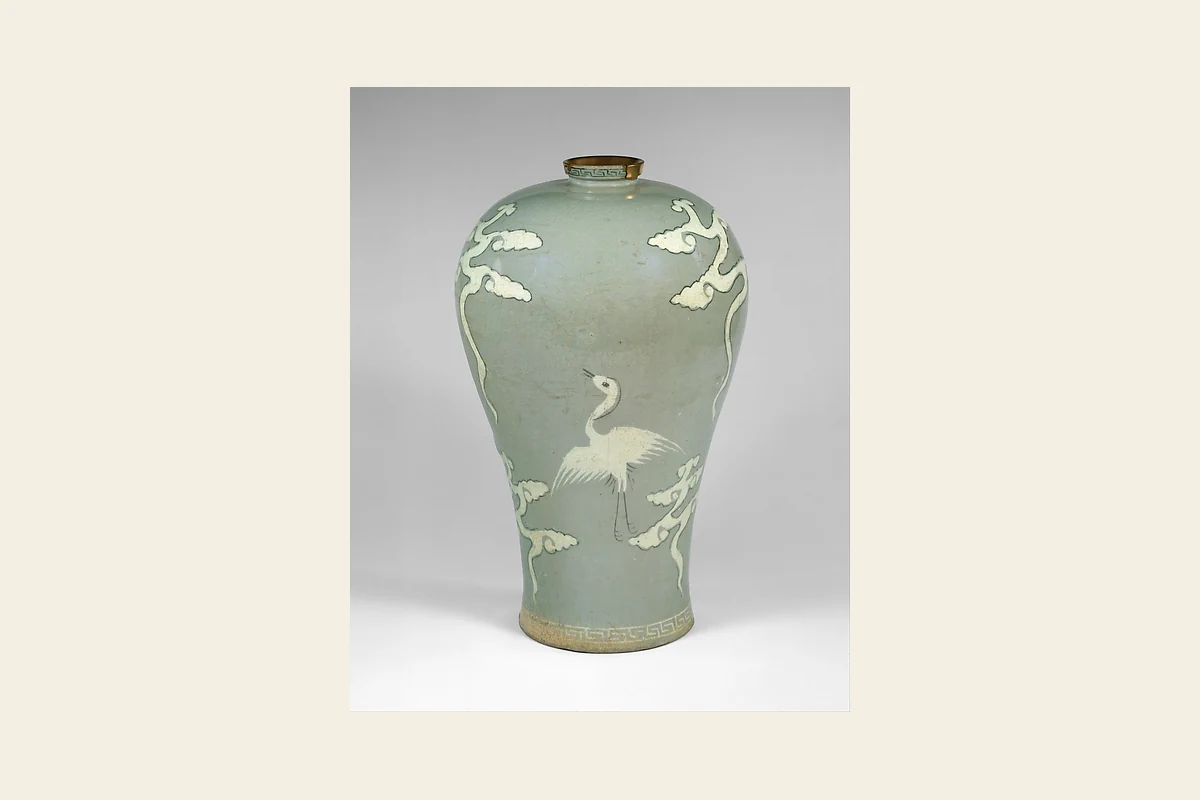
The bottle dates to the late thirteenth century, during Korea’s Goryeo dynasty. Its shape is called a maebyeong. The broad shoulders leave room for clouds to drift around the form below its small mouth. The wall then narrows towards the foot. Trace that outline with your finger while ignoring the decoration. At what point does it begin to turn sharply inwards? The Met, plum bottle with cranes and clouds
Where the white goes
The inlay process is called sanggam. The potter cuts a recess into the clay body, fills it with contrasting liquid clay, applies a translucent glaze and fires the piece. Imagine a tiny cross-section through a wing. The pale fill sits alongside the body clay and a continuous layer of glaze passes over them. That sequence accounts for the crisp pale edge beneath a single sheen. Soyoung Lee, Goryeo Celadon, The Met
Leave a little sky ahead of the bill
Follow the neck of the bird low on the front of the bottle. Notice how quickly its width changes on the way to the head. Now attend to the green patch ahead of the bill. The gap can make the crane seem to have room to move. Cover part of the gap with your finger and see whether the bird seems more hemmed in, even though the outline of the wing remains visible.
A mark from a later moment
The museum identifies a repair at the mouth made with lacquer and powdered gold. It is worth pausing over even if you came to look at the birds. Locate the repair at the edge, then return to the inlaid white lower on the vessel. Two things you can see in the same photograph record very different moments in the life of the bottle. The Met, plum bottle with cranes and clouds
Look across the bowl, then into it
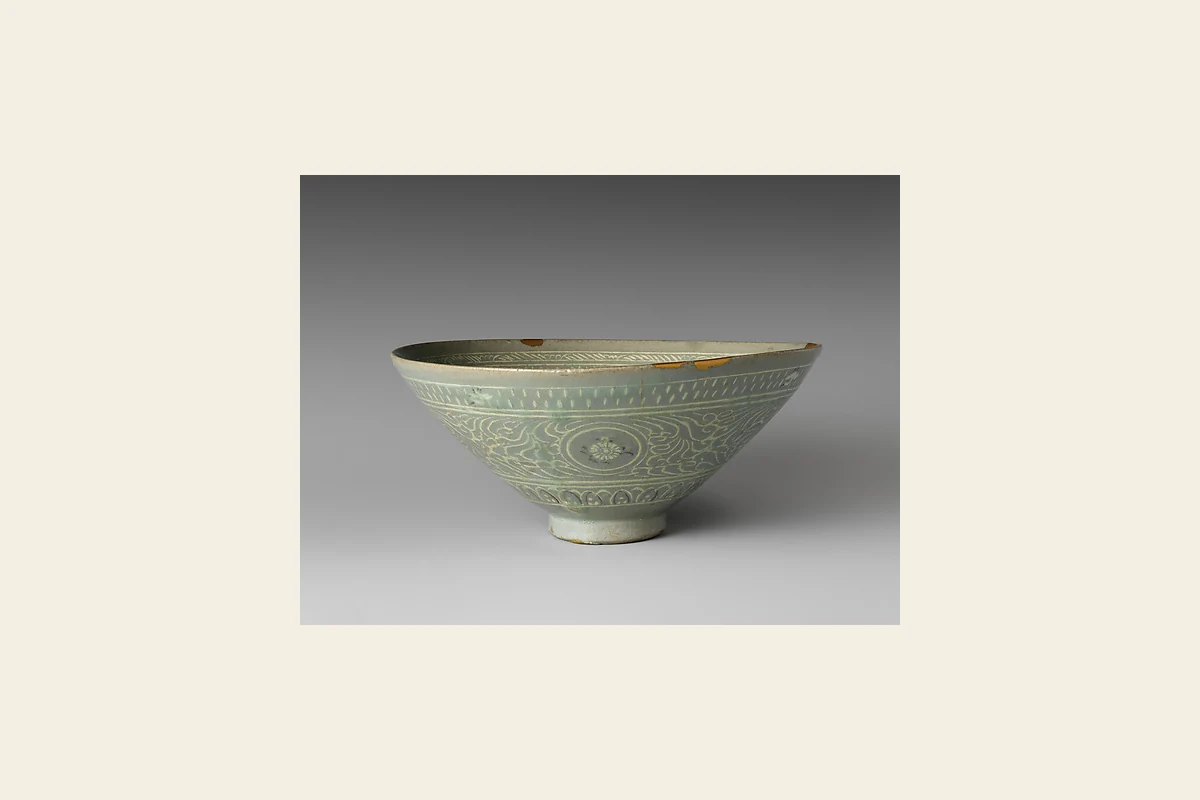
The early fourteenth-century bowl pictured below has sloping walls with bands of decoration visible across the outside. Open the alternate photographs in its collection record and look down over the lip. The interior holds four cranes in rain and a chrysanthemum at the bottom. Follow a path from the circular rim to that flower. The side view gives you no chance to make that particular journey. The Met, bowl with cranes, rain and chrysanthemums, with alternate views
Wrap a design around a cup
Cut a strip of light paper about two fingers wide. Sketch two simple birds on it and wrap it around a cup. Slowly rotate the cup until one wingtip disappears. Mark that spot, flatten the strip and measure the gap between the birds. On the flat sheet you always see the entire design. On the bottle, space between motifs changes as the viewer turns it.
Frequently asked questions
Does celadon always have inlay?
Celadon refers to the glazed ceramic ware. Sanggam names an inlay technique. A Goryeo celadon vessel could also have a carved design or depend on its shape and glaze for its effect.
Can I see all four cranes in the bowl photograph here?
This side view shows the exterior. Use the alternate views in the linked museum record to compare it with the scene inside.
Continue learning with the academy
Choose a course for the skill you want to develop, and check its curriculum and lesson language on the course page.
- Pencil Shading — To draw the bottle, model the whole form in graphite before adding the birds. A value study helps the undecorated green passages turn with the sides of the vessel.
