
What you will learn
- Trace the staggered rows inside a circular rim.
- Identify the long serrated saz leaf under a tulip.
- Try the same floral motif inside a circle and a square.
Start with the painted surface
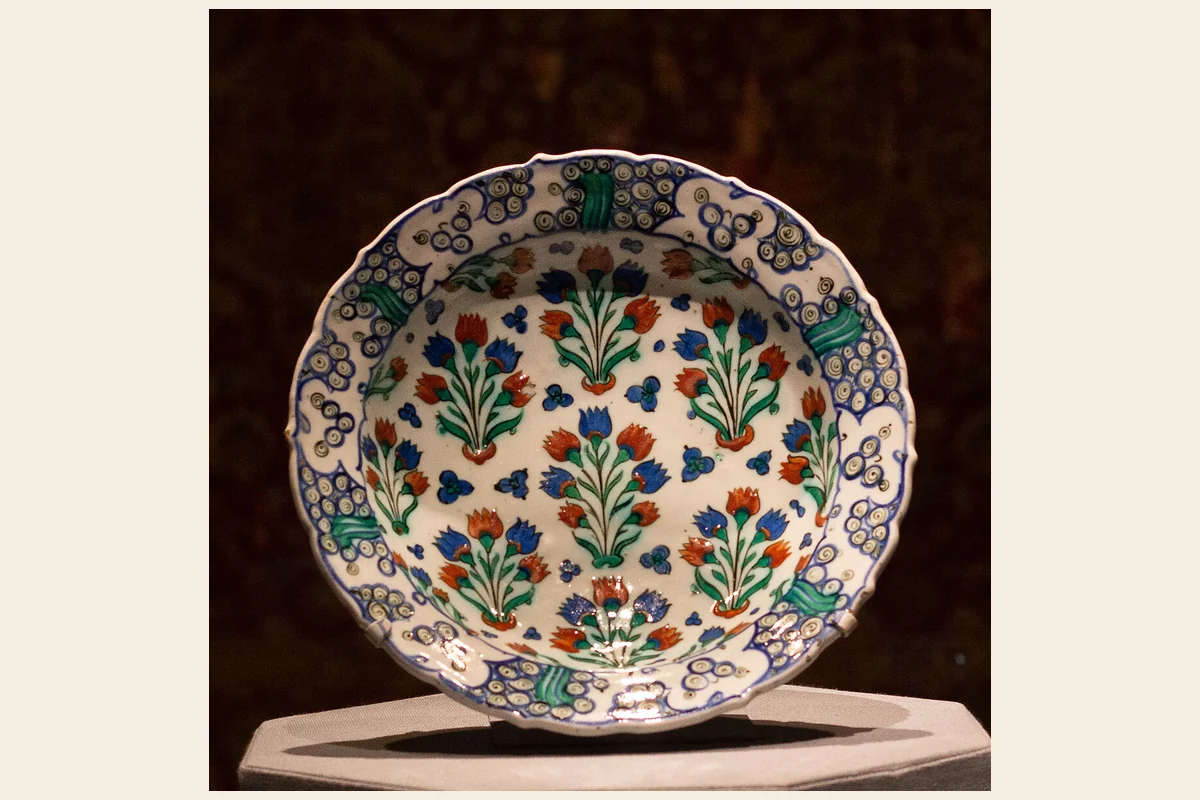
The Met identifies both objects as stonepaste decorated in several colours under a transparent glaze. A flash of reflected light can interrupt a painted mark in the photograph. Follow the mark from the other side of the highlight and see where it continues. Separating the reflection on the surface from the drawing beneath it helps when you are trying to count narrow leaves or follow a stem. The Met · Dish with Pattern of Flowering Plants · The Met · Tile with Saz Leaf, Tulips, and Hyacinth Flowers
Find the next row of tulips
The museum dates the dish to about 1565–70. Its tulips sit in staggered rows. Start with a stem near the middle and move diagonally to the next one up. Imagine stacking each plant directly above the previous one. This would open vertical lanes between columns. Moving alternate rows sideways fills part of that space. It also gives the eye more than one route across the pattern. The Met · Dish with Pattern of Flowering Plants
Read the small marks between flowers
Between the flowers are clusters of three dots, identified by the museum as çintamani. Cover one of the neighbouring tulips and notice how much space that little cluster occupies on its own. Around the scalloped rim the marks change into spiral-like forms. Follow a few with your eye. The border guides you around the circumference, while the staggered stems encourage a return across the centre. The Met · Dish with Pattern of Flowering Plants
Look for the tulip laid across the saz leaf
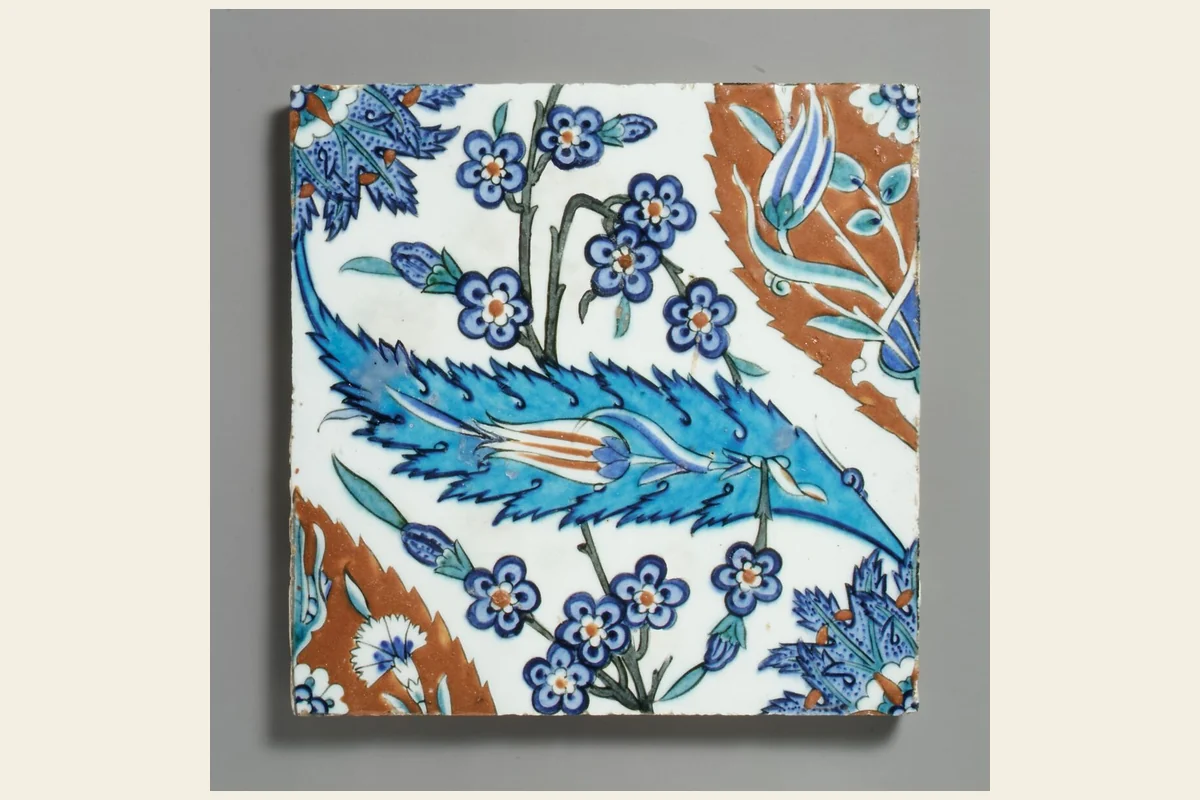
The Met attributes the tile to Iznik and dates it to the third quarter of the sixteenth century. A long serrated saz leaf sweeps across the square with a tulip laid over it. Trace the blue leaf to its tip before following the narrow flower. Here the tulip creates a second line across a much larger shape. Motifs meet the edges, leaving open the question of how this surviving square fitted its original panel. The Met · Tile with Saz Leaf, Tulips, and Hyacinth Flowers
Look at the leaf on two scales
The museum connects the saz manner with a Persian decorative style that reached the Ottoman court in the mid-sixteenth century. On this tile, the blue leaf can carry your attention in two ways. Each little tooth on its edge sends your eye to the next. The axis of the whole leaf carries it across a much longer distance. Cover the leaf with a scrap of paper to see which direction the smaller flowers now suggest. The Met · Tile with Saz Leaf, Tulips, and Hyacinth Flowers
Give one flower two different jobs
Draw a circle and a square. Invent a bud with two leaves. Repeat it inside the circle in two rows, offsetting the second row by half a unit. In the square, stretch a single leaf along the diagonal and lay just one of your original buds over it. Step back. Where do you find the bud first? Adjust only the spacing, then compare again to see how much work the empty ground is doing.
Frequently asked questions
How do I recognise a saz leaf?
In this example it is the long blue leaf with a saw-toothed edge. Follow its outline through the design to distinguish it from the smaller flower painted across it.
Are the colours sitting on top of the glaze?
The museum describes both objects as polychrome under a transparent glaze. Where light glints off the surface, follow the coloured outline on either side of the reflection.
Continue learning with the academy
Choose a course for the skill you want to develop, and check its curriculum and lesson language on the course page.
- Design with Adobe Illustrator — For a digital version of the spacing exercise, the Illustrator course introduces vector drawing tools you can use to duplicate a motif and adjust the repeat.
