
What you will learn
- Distinguish the historical school from a broad visual label.
- Understand how foundational studies connected with workshop practice.
- Read a design through arrangement, purpose and material decisions.
What was the Bauhaus art school?
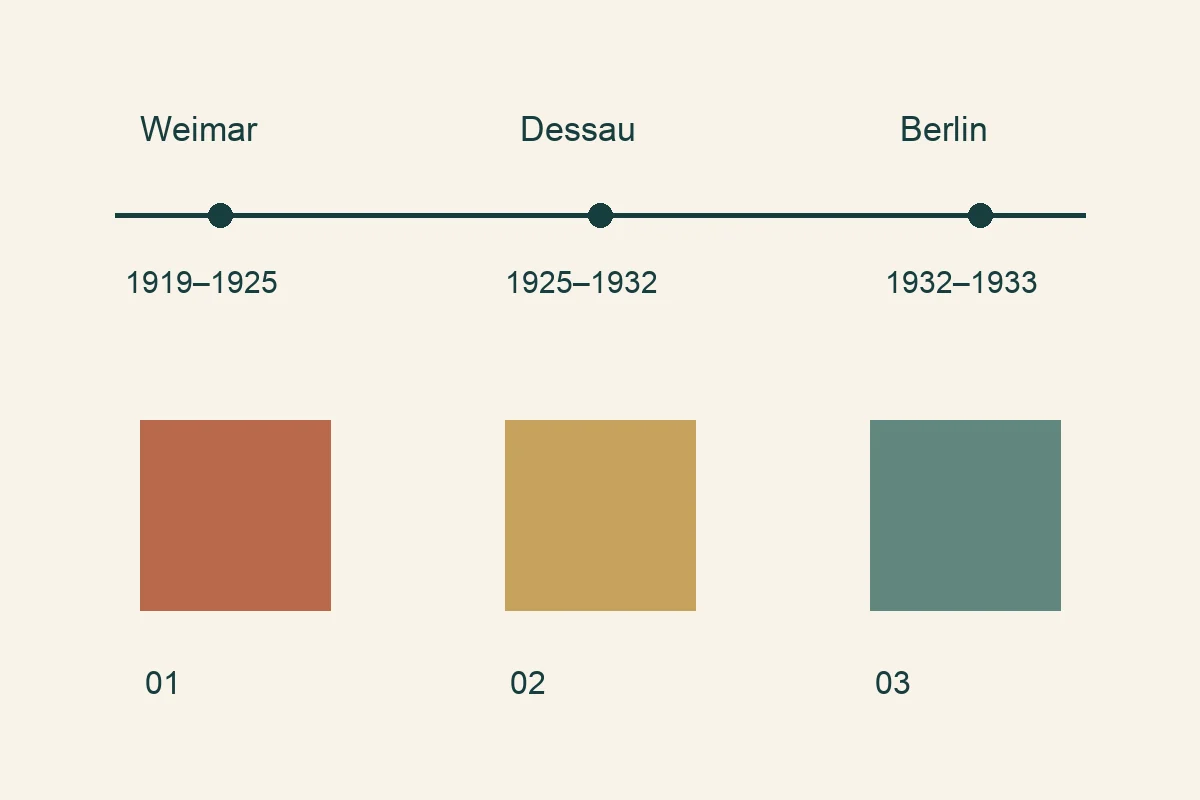
Architect Walter Gropius founded the Bauhaus in Weimar in 1919, seeking connections between fine and applied arts. The school moved to Dessau in 1925 and Berlin in 1932, ending in 1933 under Nazi pressure. These dates place it within political and institutional history rather than treating it as a timeless decorative formula. Getty Research Institute: History of the Bauhaus
When a product is described as Bauhaus style, separate a historical attribution from a later visual reference. Was the object made at the school, or is it a contemporary design borrowing associated features? A maker, date and reliable provenance can support an attribution. A red circle alone cannot.
Learning through colour, form and materials
Getty’s archive explains a preliminary course covering colour, form, composition, materials and observation before specialist workshops. Johannes Itten, László Moholy-Nagy and Josef Albers taught foundational studies at different stages; Paul Klee, Vasily Kandinsky and others contributed theoretical teaching. Getty: Principles and Curriculum
For a learner today, the useful idea is to make decisions through visible tests. How does a sheet behave when folded? What happens to a composition when one colour area grows? An experiment need not produce a permanent rule. Its value lies in making a choice concrete enough to compare and revise.
Workshops widened the field of art
Bauhaus workshops included weaving, printing, ceramics, carpentry, metalwork and stage design. MoMA’s exhibition presented work across fields by teachers and students, including Anni Albers, Gunta Stölzl and Marianne Brandt. This range challenges a view of the school limited to geometric paintings. Getty: Principles and Curriculum · MoMA: Bauhaus 1919–1933, Workshops for Modernity
Look at a textile by following the rhythm of threads and repeated colours. Look at a chair by asking how it supports a body and how its parts connect. These are suggested viewing questions, not a claim that one unchanged method governed every year of the school. Moving between media can enrich visual thinking even when drawing is your main practice.
Read a design beyond its surface style
Choose a contemporary cover or poster you own. Describe its purpose in one sentence: presenting a title, organising information or announcing an event. Cover small details with your hand and look at the main areas. Which occupies the most space, and where does your eye begin?
- Make a thumbnail of no more than three rectangles for the title, image and open area.
- Identify the strongest contrast: large and small, dark and light, filled and empty. Ask whether it supports the intended reading order.
- Check the alignment of two or three elements. Imagine moving one and assess whether the important information remains clear.
- Imagine the design reduced to two values. If the hierarchy disappears, colour may be doing more organisational work than the layout.
A contemporary paper experiment
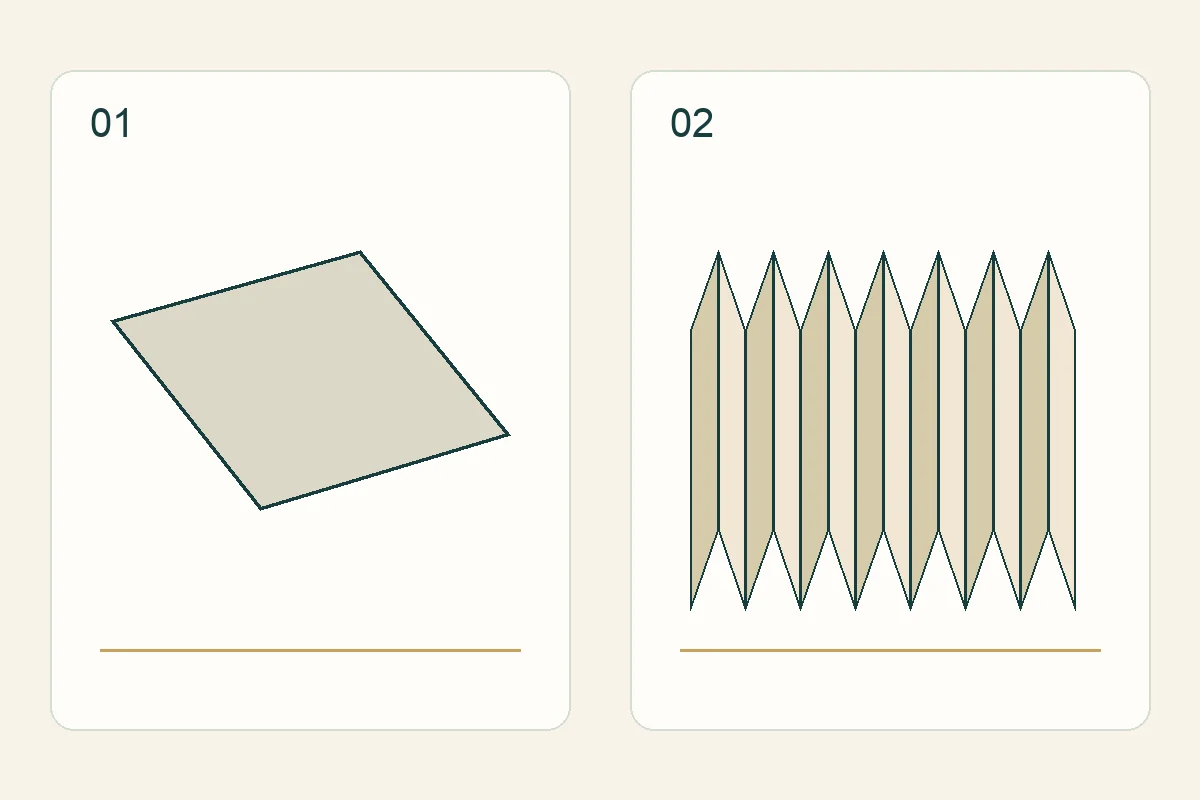
Take two sheets of the same paper and size. Leave one flat and fold the other into parallel pleats. Gently stand each on an edge on a table without adding any load. Note how folding changes stability and shadow. This is an original exercise suggested here to explore structure, rather than a reconstruction of a particular historical assignment.
Draw both arrangements with simple lines, then change the light direction and compare shadows. The aim is not to prove that one form is universally better. A folded sheet may suit one test while making a written line difficult to read; purpose belongs in the decision. Ordinary paper is sufficient, with no cutting or sharp tools required.
What a visual shorthand leaves out
A circle, triangle and square can introduce a discussion, but cannot tell you who made an object, whom it served or how it was produced. Begin a historical reading with its catalogue record, then examine material, scale and use. The diagrams in this article were made today to explain ideas; they are not archival Bauhaus works.
MoMA frames the school through collaborative experiments in art, architecture and design. Getty also notes that formal architectural courses began only in 1927. Building could be central to an ambition without being taught in the same way from the outset. MoMA: Bauhaus 1919–1933, Workshops for Modernity · Getty: Principles and Curriculum
Finish with one question you can sketch: what changes if the material changes but the shape remains, or if the same material is arranged differently? Draw two versions to test a modest hypothesis. Historical knowledge can inform present practice while your new experiment remains clearly separate from a historical document.
Frequently asked questions
Was the Bauhaus a school or a design style?
It was a historical school founded in 1919 and closed in 1933. The name is also used more broadly for later design associated with its influence; attributing a specific work requires evidence.
Do primary colours make a design Bauhaus?
No. Colours cannot establish authorship or provenance. Examine the maker, date, material, function and educational or production context.
Are the illustrations historical Bauhaus documents?
No. They are contemporary explanatory diagrams made for this article, identified as such in their captions.
Continue learning with the academy
Choose a course for the skill you want to develop, and check its curriculum and lesson language on the course page.
- Design with Adobe Illustrator — Practise arranging shapes and compositions digitally. This is not a specialist course in Bauhaus history; check the actual lesson language.
- Embroidery and Crochet — For hands-on work with thread, rather than a reconstruction of historical Bauhaus weaving teaching.