What you will learn
- Use repetition, symmetry and framing as questions for looking.
- Identify a documented Indian object with a public-domain image.
- Draw a simple eight-point star without presenting it as a historical reconstruction.
Many regions, materials and contexts
Islamic art is not limited to one region or to religious objects. The Met’s collection includes sacred and secular work from Spain and Morocco through Central Asia to Indonesia. Read an object’s place, date and material before applying a single description to centuries of production. The Met: Department of Islamic Art
Geometric ornament appears alongside calligraphy and vegetal designs, and can also coexist with human or animal imagery. The Met traces some geometric elements to earlier traditions that artists adapted and elaborated. Historical reading follows those changes rather than seeking one inventor for every shape. The Met: Geometric Patterns in Islamic Art
Three useful terms for looking
A repeat unit is a part whose return you can follow; it may be more complex than the smallest visible shape. Symmetry describes relationships that can be compared across an axis or through rotation. A frame sets a boundary where a pattern may stop or adapt. Use these ideas as questions rather than rules imposed on every object.
Start at a clear point and trace one route to a similar point. Does it return horizontally, vertically or in another direction? What changes near the edge? Do not assume that every apparent interlace represents one continuous band. A small photograph may not show enough detail to establish how all its connections work.
A documented example: an Indian jali
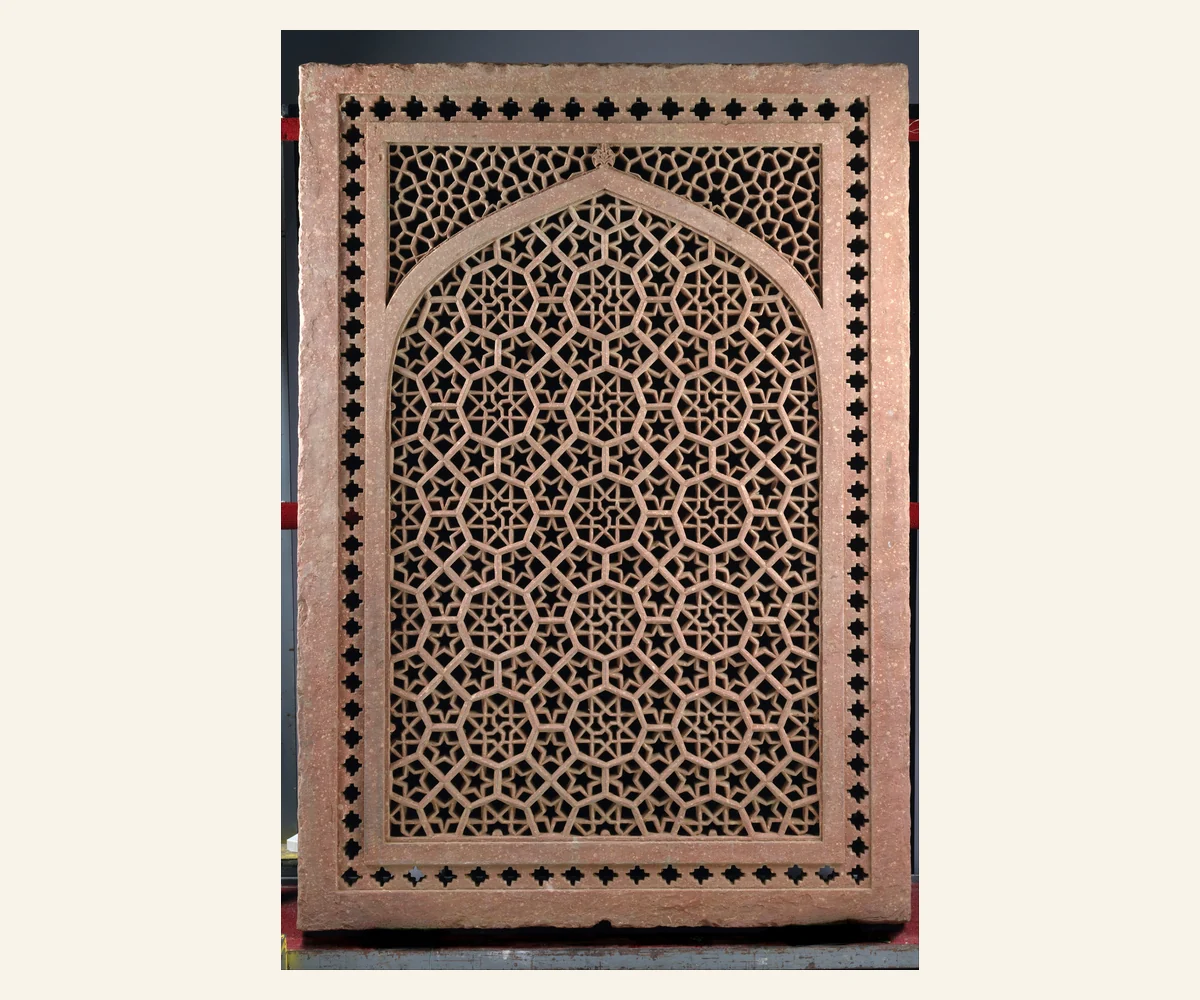
The illustrated Pierced Window Screen, or jali, was made in India in the second half of the sixteenth century from pierced and carved red sandstone. Its Met accession number is 1993.67.2, acquired through the Rogers Fund in 1993. The museum records the use of such screens as windows, room dividers and railings. The Met: Pierced Window Screen (Jali), 1993.67.2
In the photograph, a rectangular outer frame surrounds an arch and a network of star-like shapes and neighbouring polygons. These are visual observations, not a complete reconstruction of the stoneworker’s geometric method. Compare the centre and corners: where does the direction change, and how does the frame reorganise an otherwise repeating field?
Material and light change the reading
The museum record connects pierced screens with the moving shadows their openings cast during the day. Stone, empty space and light therefore matter alongside the carved lines. A dark-backed photograph makes openings legible, but does not reproduce the experience of seeing the screen installed in a building. The Met: Pierced Window Screen (Jali), 1993.67.2
Cover part of the image and follow the edge of one opening. Then shift attention to the stone surrounding it. What you treat as the main shape changes. Describe the observation precisely, for example by noting a recurring direction near the border, instead of making a broad judgement that all ornament looks the same.
An independent eight-point star study
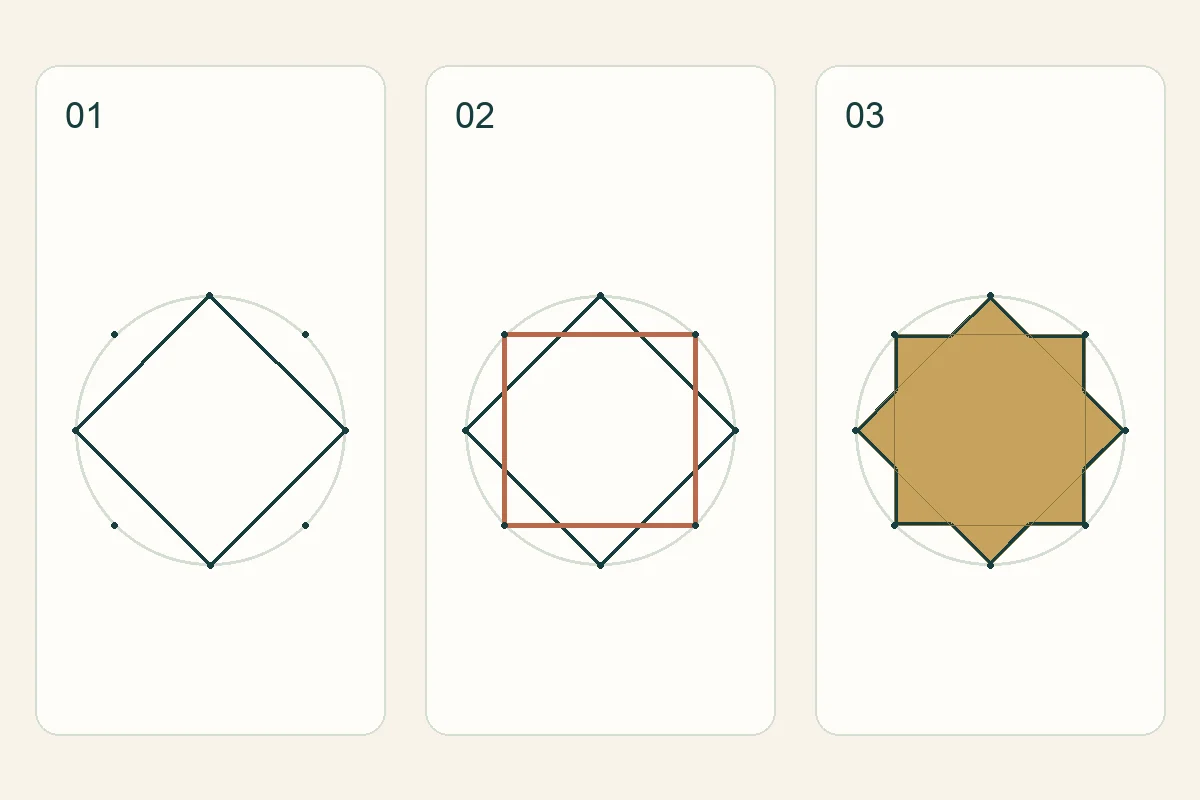
This contemporary diagram does not reconstruct the illustrated jali. Draw one square, locate its centre using the diagonals, then add an equal square rotated 45 degrees around the same centre. Their outer boundary forms an eight-point star. Squared paper and a protractor can help you compare the construction.
- Lightly draw a guide circle and centre. Mark four equally spaced points for the first square.
- Place four further points halfway between those angular positions, then join each group of four to form the two squares.
- Trace the outer boundary while leaving construction lines light enough to distinguish the method from the result.
- Repeat the shape in three separate equal boxes and compare the gaps. This makes a simple rhythm, rather than a complete tessellation.
Interpret meaning with care
A repeated field may suggest continuity or rhythm to you, but that is your interpretation unless historical evidence supports a particular intended meaning. Avoid assigning one fixed religious meaning to every star or identifying a maker from a pattern alone. Keep documented information and your own observations in separate notebook columns.
The Met’s teaching resources use compass and straightedge work to explore geometric relationships. Begin with such a study, then compare it with a documented object, while keeping a modern exercise separate from claims about a historical artisan’s exact working method. The Met: Geometric Design in Islamic Art
For digital practice, build a simple unit with vector tools and compare alignment and spacing before multiplying it. If calligraphy interests you, notice its own proportional and rhythmic decisions while treating letter construction as a distinct discipline. The course recommendations below support related skills; they are not specialist courses in the history of Islamic geometric ornament.
Frequently asked questions
Is every geometric pattern Islamic art?
No. Geometry appears in many cultures. Place, date, context and the particular object support an attribution; a star or circle alone does not.
Does the star diagram copy the illustrated jali?
No. It is a simplified contemporary study made with two overlapping squares. The Indian object has a more complex network that this article does not reconstruct.
May I reuse the object image?
The Met marks this object image as public domain, and its Open Access policy makes such images available under CC0. Check the linked object record and rights policy beneath the image.
Continue learning with the academy
Choose a course for the skill you want to develop, and check its curriculum and lesson language on the course page.
- Design with Adobe Illustrator — Practise vector shapes and alignment. This is not a specialist course in Islamic geometric ornament; check its actual lesson language.
- Arabic Calligraphy: Naskh Script — Learn Naskh as a distinct practice involving proportion and rhythm, rather than a substitute for studying geometric pattern.