
What you will learn
- Understand shanshui as a starting term, not one uniform painting style.
- Notice how format, marks and open passages shape the viewing experience.
- Separate close-looking observations from historical claims and personal interpretation.
What does shanshui mean?
The Met explains shanshui as “mountains and water,” the Chinese term for landscape. Its exhibition account notes that water can dominate the relationship, particularly in scholar-amateur painting. The term therefore offers an entry point without requiring a mountain peak to fill every picture. The Met: Streams and Mountains, Exhibition Themes
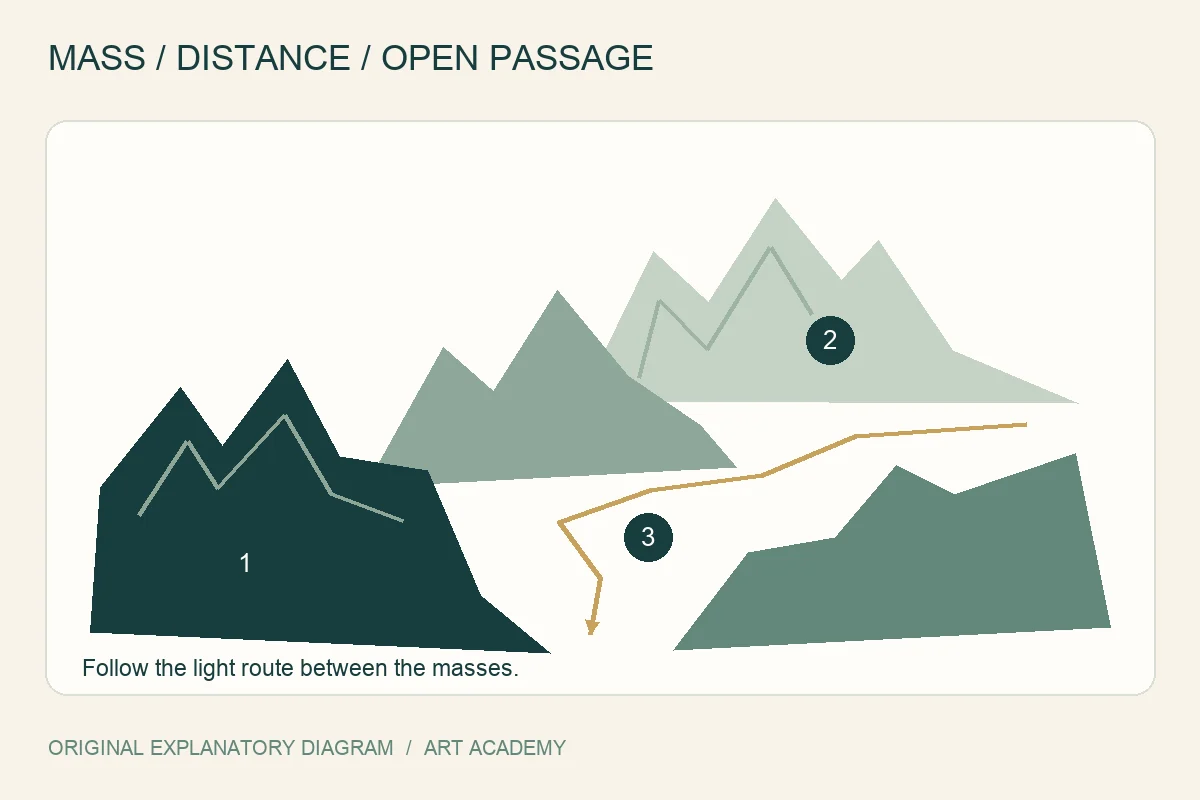
Read the two elements as an invitation to compare relationships. Where does a solid-looking area meet a pale one? What connects one bank to another? In our diagram, a clear passage links separate masses. That is a contemporary exercise in composition, not a claim that every historical painter organised a picture this way.
A landscape can carry human concerns
The Met traces landscape’s development as an independent genre to the late Tang period. Its historical overview connects later landscape imagery with retreat, self-cultivation, political circumstances and personal expression. These contexts explain why a painted setting may communicate more than the appearance of a particular place. The Met: Landscape Painting in Chinese Art
Avoid turning that range into one universal spiritual message. Before assigning a meaning, look for a catalogue explanation, an inscription translation or reliable information about the artist. If those are unavailable, describe what the image does to your attention. “The small building draws me towards the bank” is a defensible observation; a confident claim about the artist’s beliefs requires further evidence.
A handscroll changes the pace of looking
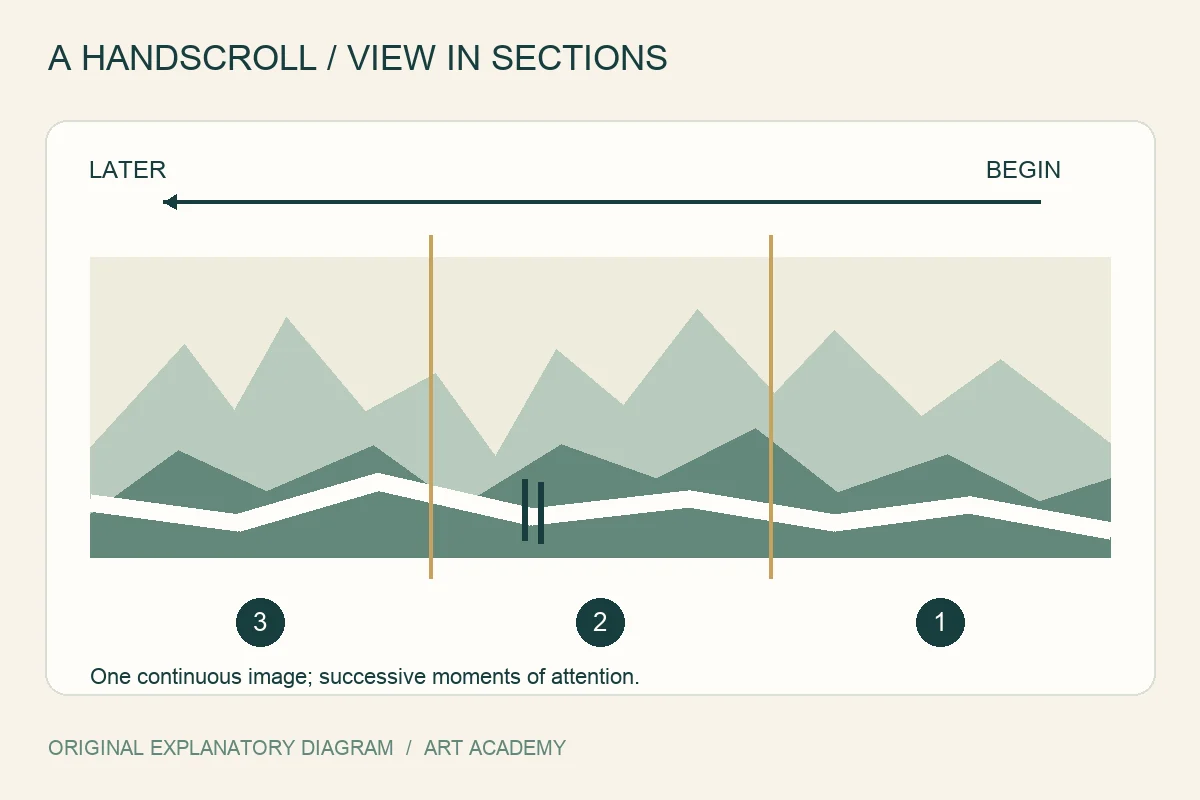
A handscroll is a horizontal roll, distinct from a hanging scroll. The Met describes viewing it from right to left, one section at a time. Inscriptions and later comments can accompany the image, while seals may belong to artists, collectors or other viewers. The Met: Chinese Handscrolls
A whole-scroll image on a screen compresses this encounter into a single glance. Try slowing it down with the sequence in our second diagram. Begin at the right and pause before moving left. Ask what each new section adds, and which earlier detail remains in your memory. This screen exercise approximates a sequence; it does not reproduce handling the original object.
A specific example: Mi Youren’s Cloudy Mountains
Cleveland Museum of Art records Mi Youren’s Cloudy Mountains as a handscroll dated 1130, made with ink and colour on silk. Its account connects the painting with his southward displacement and identifies accumulated wet ink dots as part of its hazy effect. Use the Cleveland record, accession 1933.220, for this example. Cleveland Museum of Art: Mi Youren, Cloudy Mountains, 1130
Open the museum image and compare a dense cluster with a quieter passage beside it. Describe their edges: sharp, broken, soft or difficult to locate. Then look at whether small marks gather into a larger mass. These are suggested observation questions, not a reconstruction of the artist’s exact sequence of brush movements.
Keep the title, date and collection together in your notes. Similar titles occur on different works, and a search result alone can lead you to another object. A museum’s image is also a reproduction: its screen colour and apparent size cannot fully convey the physical silk or the experience of the scroll.
Read open areas without rushing to fill them
Choose one pale passage between darker forms. Cover it briefly with an ordinary sheet held in front of the screen, then reveal it. Does the space connect distant areas, separate two masses, or give your eye a pause? It may do several things. Use the local evidence around its edges before deciding whether it represents water, mist, sky or something you cannot identify.
Do not assume that every light area is untouched support; reproductions and painting techniques differ. The exercise concerns the visible relationship between areas, not a technical diagnosis of a surface you have not examined. Write your observation as a question when necessary, and let uncertainty guide the next look.
Make a three-window viewing journal
Draw three empty rectangles on ordinary paper. Use our schematic sequence or the museum’s digital image as your reference. This is an original observation exercise for the article, not a traditional Chinese painting lesson. No specialist brush, ink or paper is required.
- Starting on the right, look at the first section for one minute. Record only its largest dark area and the route of one pale passage.
- Move left to the next section. Add a small sketch and a sentence explaining what changed in scale, density or direction.
- Study the final section, then hide the reference. Describe one connection you remember across all three windows.
- Reveal the reference and correct your notes. Distinguish something you actually saw from a connection you inferred; keep both, clearly labelled.
Carry the attention into your own drawing
For a small follow-up, arrange two dark shapes on a page and leave a connected light passage between them. Make a second version that narrows the passage. Compare the route your eye takes. This explores one visual relationship without claiming to reproduce the training, materials or cultural context of shanshui.
When you return to a historical work, give equal attention to its object record and its visible structure. Ask what further information would change your reading. A useful first encounter ends with more precise observations and better questions, rather than a single explanation intended to cover an entire painting tradition.
Frequently asked questions
Are all Chinese landscapes handscrolls?
No. Check the format in the museum record. A horizontal handscroll calls for a different viewing exercise from a hanging scroll or an album leaf.
Is this exercise a lesson in traditional Chinese brush painting?
No. It develops observation and composition using ordinary drawing materials. Learning a specific brush tradition requires instruction in its own tools, methods and context.
Continue learning with the academy
Choose a course for the skill you want to develop, and check its curriculum and lesson language on the course page.
- Pencil Shading — For separate practice with light and dark values in graphite. The course is taught in Arabic and does not teach traditional Chinese ink painting.