
What you will learn
- Recognise the role of planes, shifting viewpoints and shallow space.
- Distinguish analytical fragmentation from constructing an image with broad shapes.
- Build an interpretation from visible evidence and a reliable object record.
Where did Cubism begin?
Cubism developed through Pablo Picasso and Georges Braque’s exchanges in Paris between 1907 and 1914. MoMA describes its angular forms, compressed space and frequent combinations of viewpoints. The movement spread beyond these two artists; its name does not describe one identical method used by everyone. MoMA: Cubism
That historical frame helps, but it is not a decoding key. A date and an artist’s name tell you where to begin comparing works. They do not make every triangle meaningful in the same way. Start by separating what the catalogue establishes from what you can actually point to in the image.
Look for relationships before objects
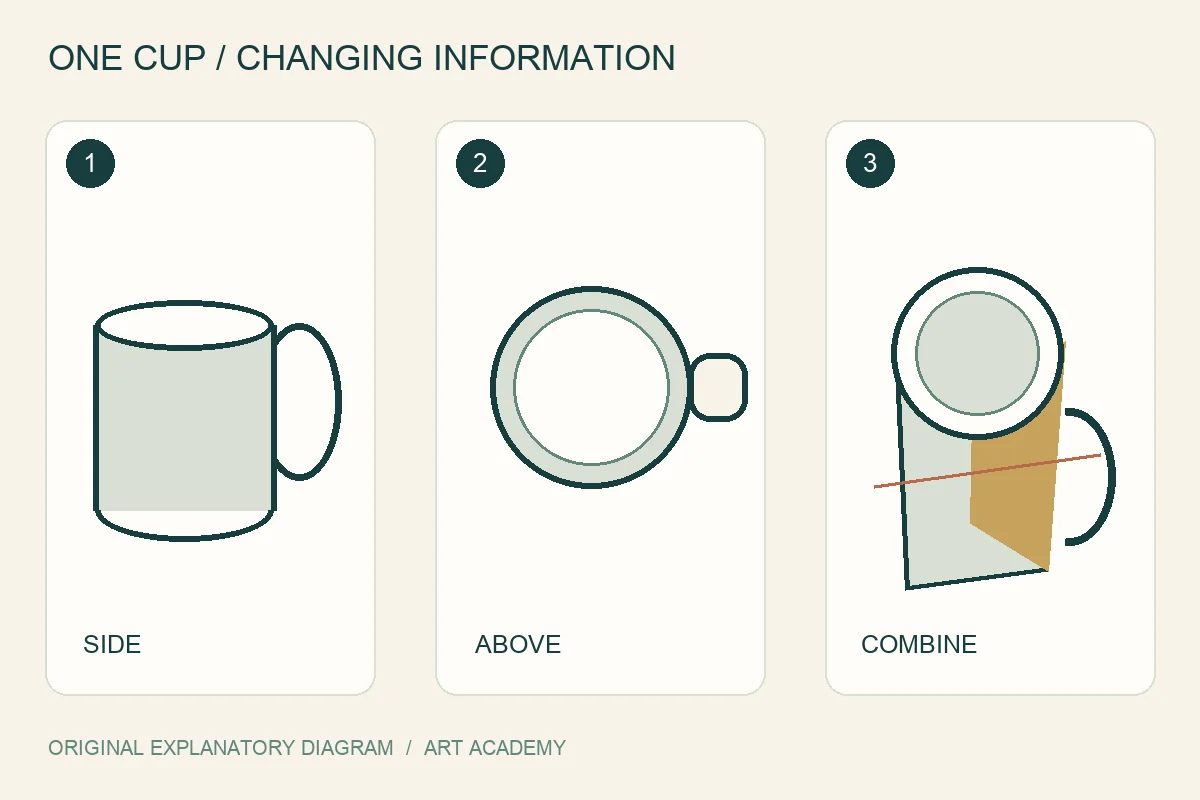
Imagine a cup viewed from above and then from the side. Its opening changes from a circle to an ellipse, and its handle becomes more or less visible. Our diagram combines selected information from those observations. It is a limited teaching device, not proof that a particular painter followed this procedure.
In a painting, follow a boundary until it stops. Does the adjacent patch seem to belong to the same object, or to the surrounding space? Try tracing only three connected edges on a separate thumbnail. A broken contour can make recognition tentative; your uncertainty is something to examine, rather than an error to eliminate immediately.
Analytic and Synthetic Cubism
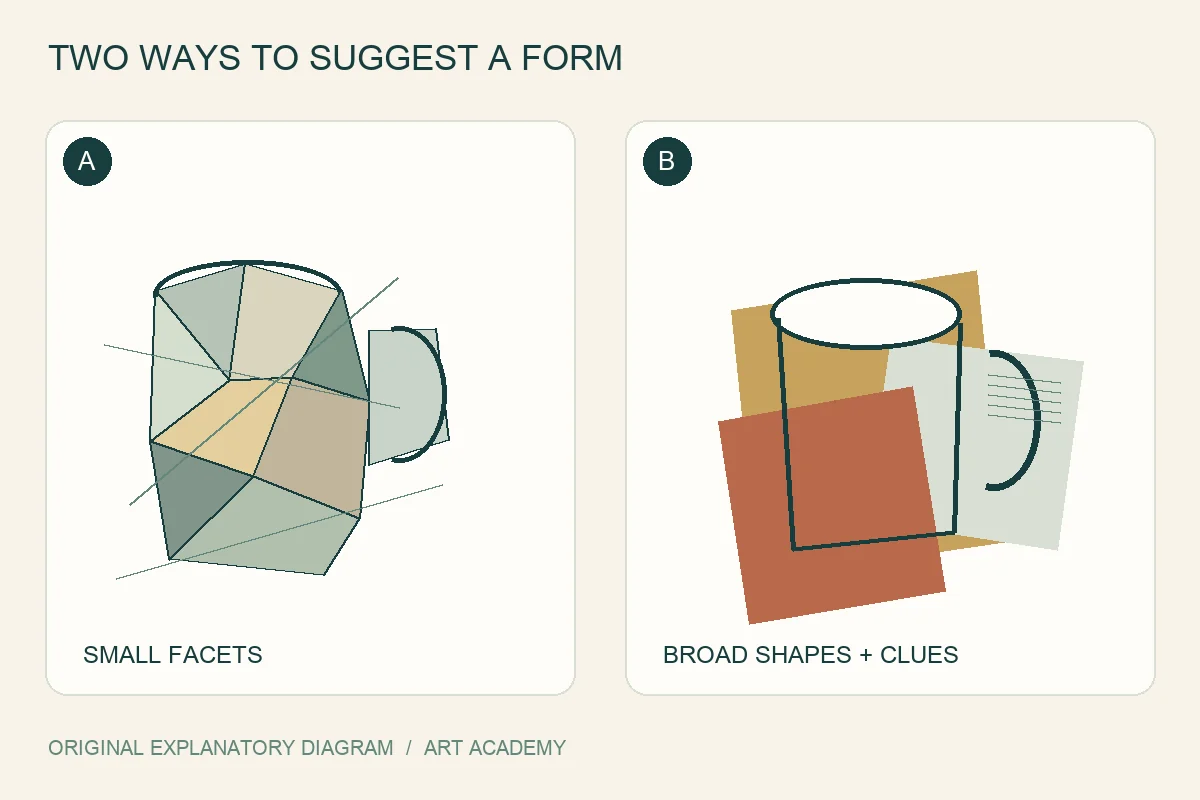
The Met describes Analytic Cubism of 1910–12 through small overlapping facets and a restrained palette. In Synthetic Cubism, associated with pasted-paper experiments, broader pieces could suggest objects through shape or graphic clues. These labels help compare different ways of making an image. The Met: Cubism
Use the second diagram as a question, not a sorting machine: does recognition emerge from many small divisions, or from a few constructed signs? Actual works can be more complex than either demonstration. Colour alone will not settle the classification. Check how outlines, materials and patches work together, and return to the museum’s account of the particular object.
Test your observations against two works
MoMA dates Picasso’s Girl with a Mandolin (Fanny Tellier) to late spring 1910 and identifies its medium as oil on canvas. Its account describes the figure’s transformation into geometric planes in muted colours. Open the linked museum image to examine that specific work. MoMA: Picasso, Girl with a Mandolin
First locate the head and the instrument without trying to complete the whole body. Then choose a neighbouring patch whose role seems less certain. Write two possible readings and identify the edge supporting each. This is our suggested exercise, not a statement of the sitter’s feelings or Picasso’s intentions.
For comparison, MoMA records Braque’s Still Life with Tenora, 1913, as cut-and-pasted printed and painted paper with charcoal, chalk and pencil on prepared canvas. The medium matters: some shapes are attached materials, rather than only painted representations of materials. MoMA: Braque, Still Life with Tenora
A ten-minute experiment with one cup
Place a plain cup on a table and make two small observations, keeping each drawing separate at first. You need only ordinary paper and a pencil. The aim is to notice which clues survive rearrangement, not to produce an authentic historical Cubist work.
- Spend two minutes drawing the opening and handle from a low position, then two minutes from a higher position. Do not move the cup between observations.
- On a third sheet, choose one feature from each study. Arrange them within a single rectangle, keeping the result deliberately simple.
- Add three large light or dark areas. Let one cross your original outline, then examine whether the cup remains recognisable.
- Write down the strongest clue and the least certain area. Compare the construction with your first drawings: what information was preserved, exaggerated or lost?
Build a reading you can support
Describe before judging: “the circular rim interrupts a vertical band” is more useful than “the image is chaotic.” Then suggest an effect: perhaps your attention alternates between the cup and the arrangement of patches. Present that as your experience of looking, not as a universal response.
When reading an unfamiliar work, record title, artist, date and medium beside your notes. If the title names an instrument, verify the object rather than guessing from a familiar outline. A persuasive reading can remain incomplete: you may understand a repeated curve or a rhythm of edges without identifying every represented thing.
Revisit the painting after your own small study. Look for one decision you had previously overlooked, such as an abrupt contour ending or an area left quiet between busy passages. The exercise succeeds when it improves your attention. A convincing imitation is unnecessary, and a short written observation can be as useful as a finished drawing.
Frequently asked questions
Does Cubism mean drawing everything as cubes?
No. Look at relationships among planes, clues, viewpoints and materials. Cubes alone do not define the movement.
Must I identify every object to understand a Cubist painting?
No. Begin with a few supported observations. The uncertainty between an object and an arrangement of shapes can be part of your viewing experience.
Continue learning with the academy
Choose a course for the skill you want to develop, and check its curriculum and lesson language on the course page.
- Pencil Shading — Practise controlling light and dark values in pencil; this is not a specialist course in Cubist art history.
- Oil Painting — Develop colour handling and still-life practice. Check the course curriculum and Arabic lesson language before enrolling.