
What you will learn
- Look at how the objects relate before interpreting an individual symbol.
- Compare the shape and sharpness of highlights on material surfaces.
- Read the two paintings together to see how composition changes the experience.
How vanitas developed within still life
The Met traces the flourishing of independent still-life painting in the Netherlands to the early seventeenth century. Some of these paintings assembled objects to reflect on the brevity of life and the transience of worldly things. The period also produced flower pieces and pictures of elaborate tables. The Met · Still-Life Painting in Northern Europe
Begin with the relationship between things on view. A panel can invite close attention to glass and paper while also placing those materials in a group that suggests passing time. That double experience is easier to appreciate after you describe what you see.
Read Claesz from the ledge inward
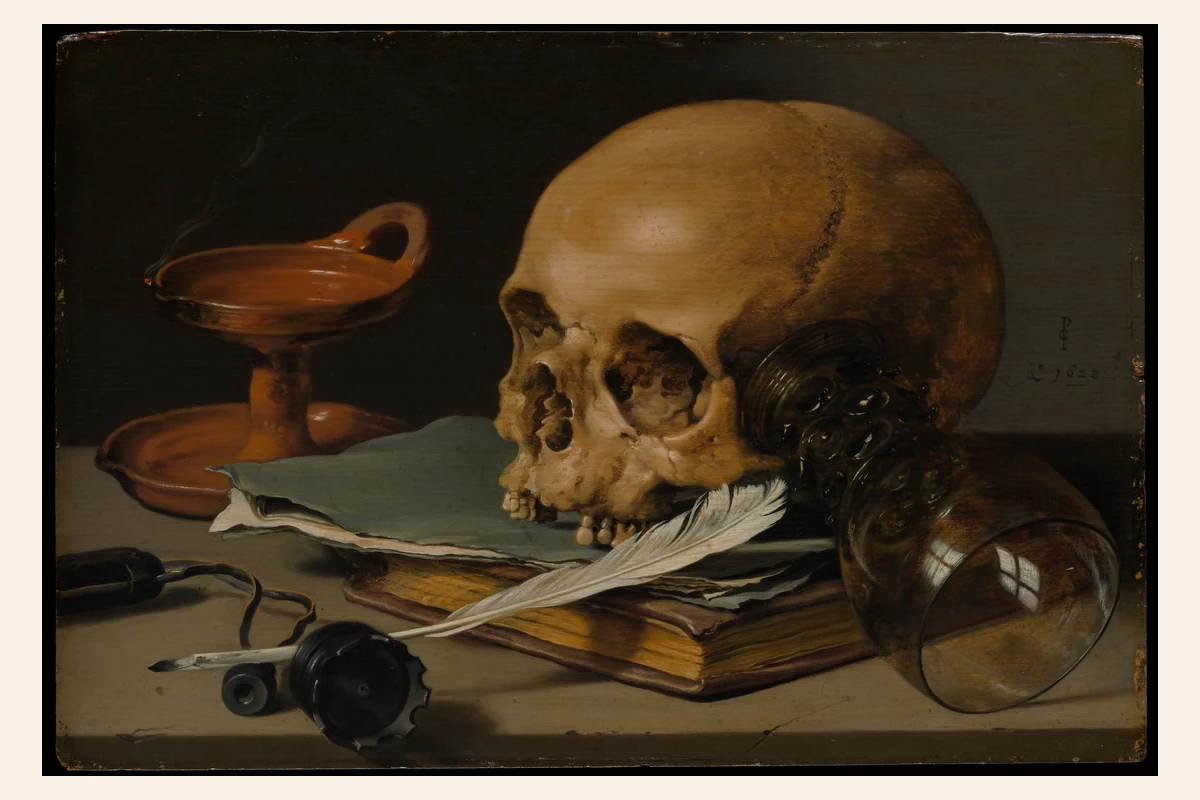
Pieter Claesz painted Still Life with a Skull and a Writing Quill in 1628, using oil on wood. The Met links the skull, tipped glass and guttering wick to life’s brevity. A worn stone ledge places the objects close to the viewer’s space. The Met · Pieter Claesz, 1628
Follow the edge of the stone towards the quill, then compare the broad light on the skull with the smaller glint on the glass. The highlights differ in shape and sharpness. In this reading, those shifts guide the eye while the overall range of colour stays quiet.
What a limited palette makes visible
The Met describes the 1628 work’s palette as largely grey and brown. In a separate painting dated 1630, the Mauritshuis points to a small touch of blue in a watch ribbon amid browns and greens. That watch belongs to the latter composition. The Met · Pieter Claesz, 1628 · Mauritshuis · Pieter Claesz, 1630
Try reducing the first painting to three groups of value. Find a relatively light surface, a middle area and a dark one, then ask where two similar colours still describe different materials. A sharp reflection and a broad patch of light tell the eye different things.
Compare Jacques de Gheyn II’s vertical panel
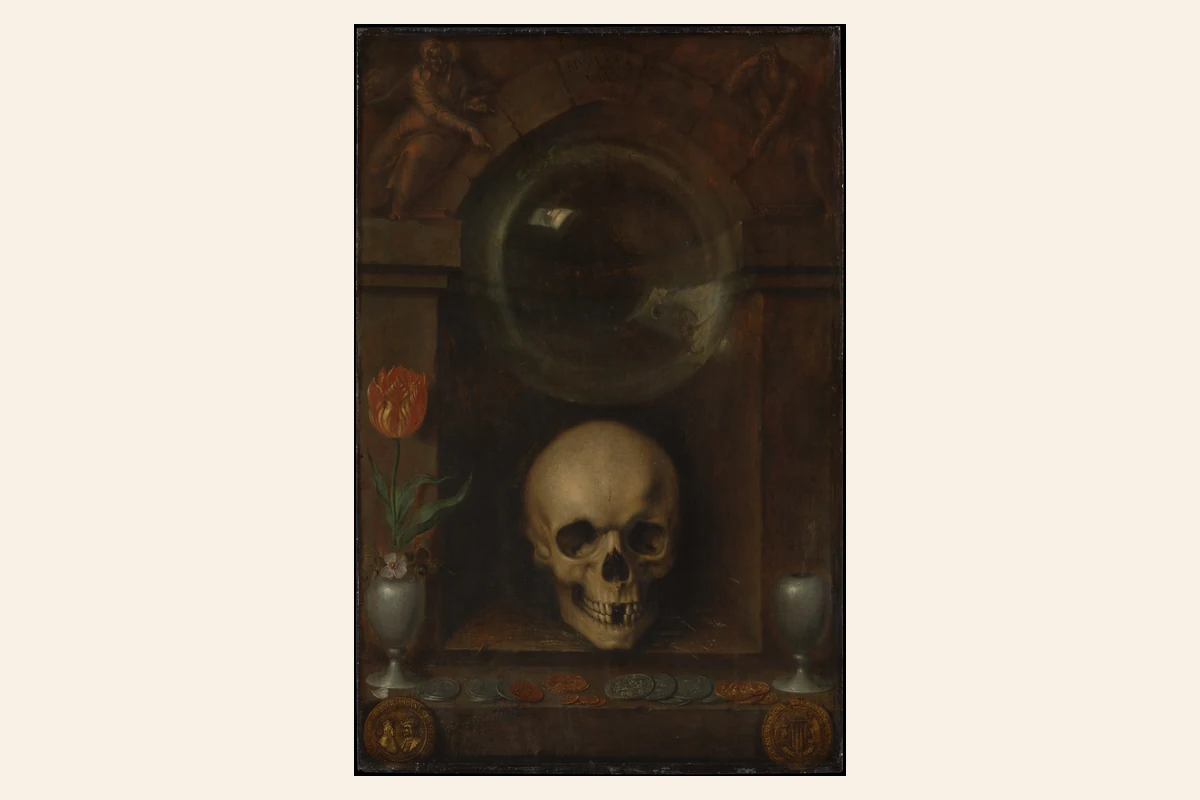
The Met generally considers the 1603 Vanitas Still Life by Jacques de Gheyn II the earliest known independent still life of the subject. The skull and bubble occupy the centre, with cut flowers and a smoking urn around them. The Met · Jacques de Gheyn II, 1603
Here the eye can climb from skull to bubble along a vertical axis. The later Claesz arrangement spreads across a low ledge that invites sideways movement. These are two ways of arranging a related subject, even before you attach a meaning to each object.
Read the objects with their surroundings
Record a visual observation first: a glass is tipped, or a bubble floats directly above the skull. Add a museum’s interpretation in a second sentence. If you propose your own reading, explain which position, shape or neighbouring object you used as evidence.
The Met’s survey includes both moralising still lifes and displays of flowers and luxury goods. A single cup is usually too little evidence to classify a painting. The other objects and the collection record help you get closer. The Met · Still-Life Painting in Northern Europe
A one-minute close-looking practice
Look at the Claesz panel without zooming in. Sketch the ledge and three blocks where you see strong objects. Mark where you first looked and where you ended. Repeat the process with De Gheyn and compare the directions you drew.
To try a related studio study, arrange three surfaces of your own under a single side light. Write one reason for including each object. Paint a small study in which a difference in texture or reflected light helps each object stay distinct.
Frequently asked questions
What does vanitas mean in a still life?
It is a subject that uses familiar objects to reflect on human mortality and the brief life of possessions, pleasures or status.
Does a skull automatically make a painting a vanitas?
Look at the work’s context and the objects around the skull. A collection record can help confirm how a particular picture has been understood.
Continue learning with the academy
Choose a course for the skill you want to develop, and check its curriculum and lesson language on the course page.
- Oil Painting — Apply the comparison of light and surface to a small oil study of three objects with one light source.