
What you will learn
- Compare the materials used in different models.
- Use the arrangement of rooms and figures to read the actions.
- Keep the setting of the tomb in view when interpreting daily-life details.
Where were Meketre’s models found?
The Met identifies Meketre as a high-ranking royal steward. The models were discovered in 1920 in a concealed chamber by the passage to his rock-cut tomb at Thebes. The museum dates the workshop and garden models to about 1981–1975 BCE, early in the Twelfth Dynasty of the Middle Kingdom. The Met · Model Bakery and Brewery · The Met · Model of a Porch and Garden
Begin with the findspot and the physical material of each work. The location in a tomb gives these small observations of daily life a funerary context. It also invites questions about why particular activities and places were chosen.
Follow the bakery and brewery room by room
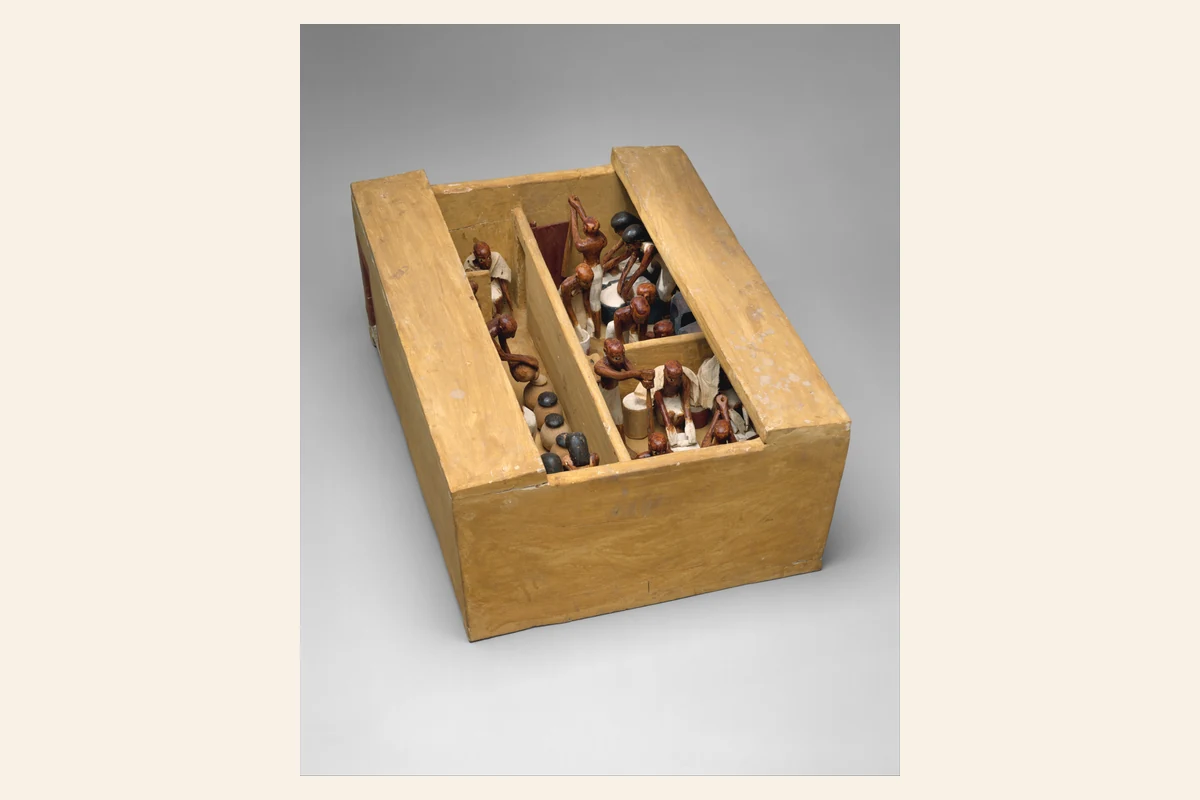
The Met describes a workshop with separate rooms for related activities. It identifies grain-grinding tools, containers for dough, ovens and vessels for fermentation. Wood, gesso, paint and linen make up the object. The Met · Model Bakery and Brewery
Start at the entrance and follow the boundary of one room. Look for a hand, a tool and the nearest vessel. Together they may suggest an action, such as moving or preparing an ingredient. Check your reading against the catalogue when the posture or use of a vessel is uncertain.
Read the porch and garden from the pool
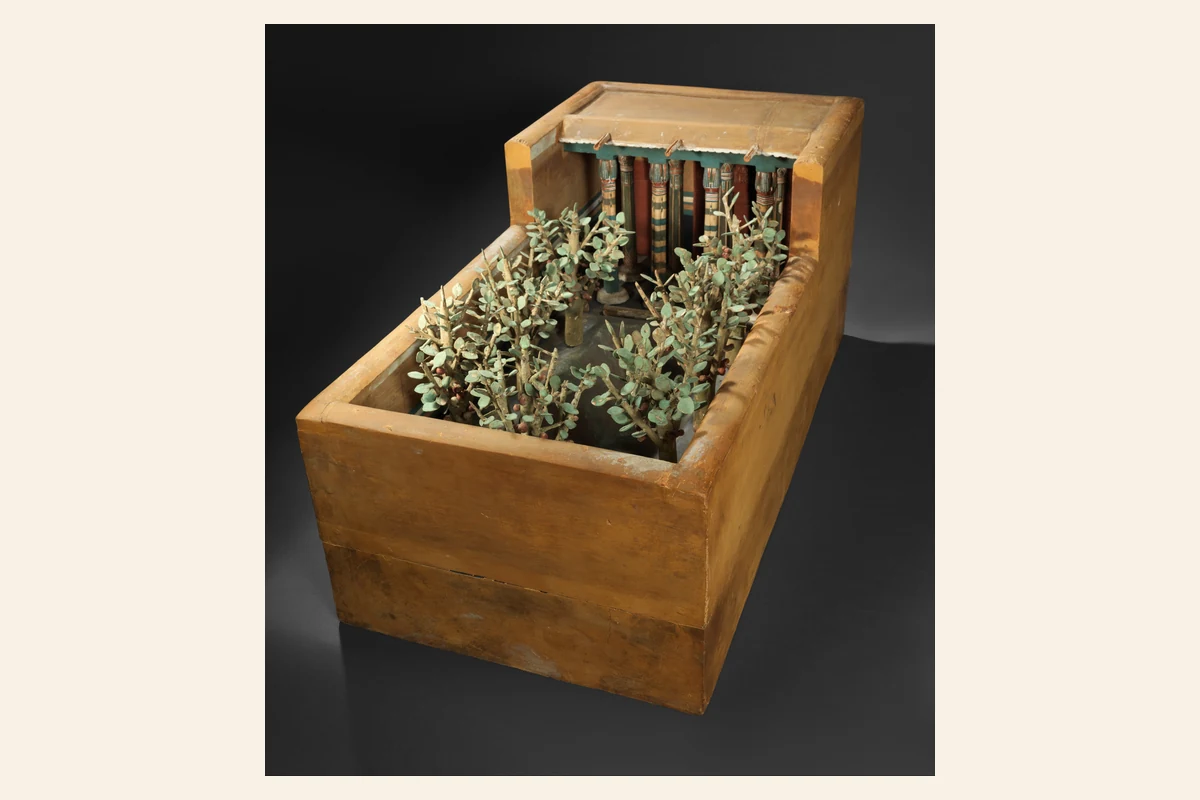
A pool lined with copper sits among fruiting sycamore fig trees, facing a portico with two rows of columns. The Met discusses a possible connection between the pool and basins used to make liquid offerings. The Met · Model of a Porch and Garden
Compare the rhythm of tree trunks and columns. The pool leaves an open centre with repeated shapes along its edges. Your eye can take in the garden around that centre, while the compartments of the workshop encourage you to look in stages.
What the granary adds
Another model from the tomb has grain storage and accounting areas. The Met identifies sack carriers and scribes, some with papyrus scrolls and some with wooden writing boards. The scene gives weighing or recording a place beside the physical transportation of grain. The Met · Model of a Granary with Scribes
Follow grain as a material shared by the granary and the workshop. Each miniature selects part of a larger chain. We can observe how a model presents that chain. The actual size of a building or the number of people working there would require other evidence.
Look at material and scale together
Look for the straight lines of the porch and compare them with the curved edges of the workshop vessels. Details are scaled so a small group of objects can be understood at a glance. From a different view, a wall or column can hide one part and bring another into view.
The catalogue gives a length of 73 cm for the workshop and 84.4 cm for the porch and garden. Those measurements and the materials listed for each work help you imagine the scale of the objects in the gallery. The Met · Model Bakery and Brewery · The Met · Model of a Porch and Garden
A five-minute exercise in looking at a model
Draw a small rectangle for each work as seen from above. Shade the separate rooms in the workshop. In the garden, mark the location of the pool, trees and porch. Identify one detail for which you would turn the model to a different angle.
Under each sketch, write one observation and one interpretation. For instance, observe that containers appear in several rooms, then ask what their separation suggests about the activities. Try the same method with another architectural model and see how the view shapes your reading.
Frequently asked questions
Who was Meketre?
He was a high-ranking Egyptian official. The group of models was discovered in a chamber connected to his tomb at Thebes.
Are the models architectural plans to scale?
They are three-dimensional representations that select elements of spaces and activities. Establishing the exact scale or form of a real building requires other architectural evidence.
Continue learning with the academy
Choose a course for the skill you want to develop, and check its curriculum and lesson language on the course page.
- Pencil Shading — After comparing the layouts, sketch the pool or a workshop vessel in three values to describe its volume.