
What you will learn
- Compare a colour with its neighbours before naming the object’s colour.
- Visible brushwork can involve careful planning and repeated revision.
- Borrow a way of observing rather than a fixed recipe for a style.
A historical beginning, not one uniform technique
In 1874, artists organised an independent exhibition in Paris. The name Impressionism became associated with Monet’s Impression, Sunrise and its critical reception. The participants differed in their approaches; modern subjects, light and colour help explain their connections without making every painting look alike. The Met: Impressionism, Art and Modernity
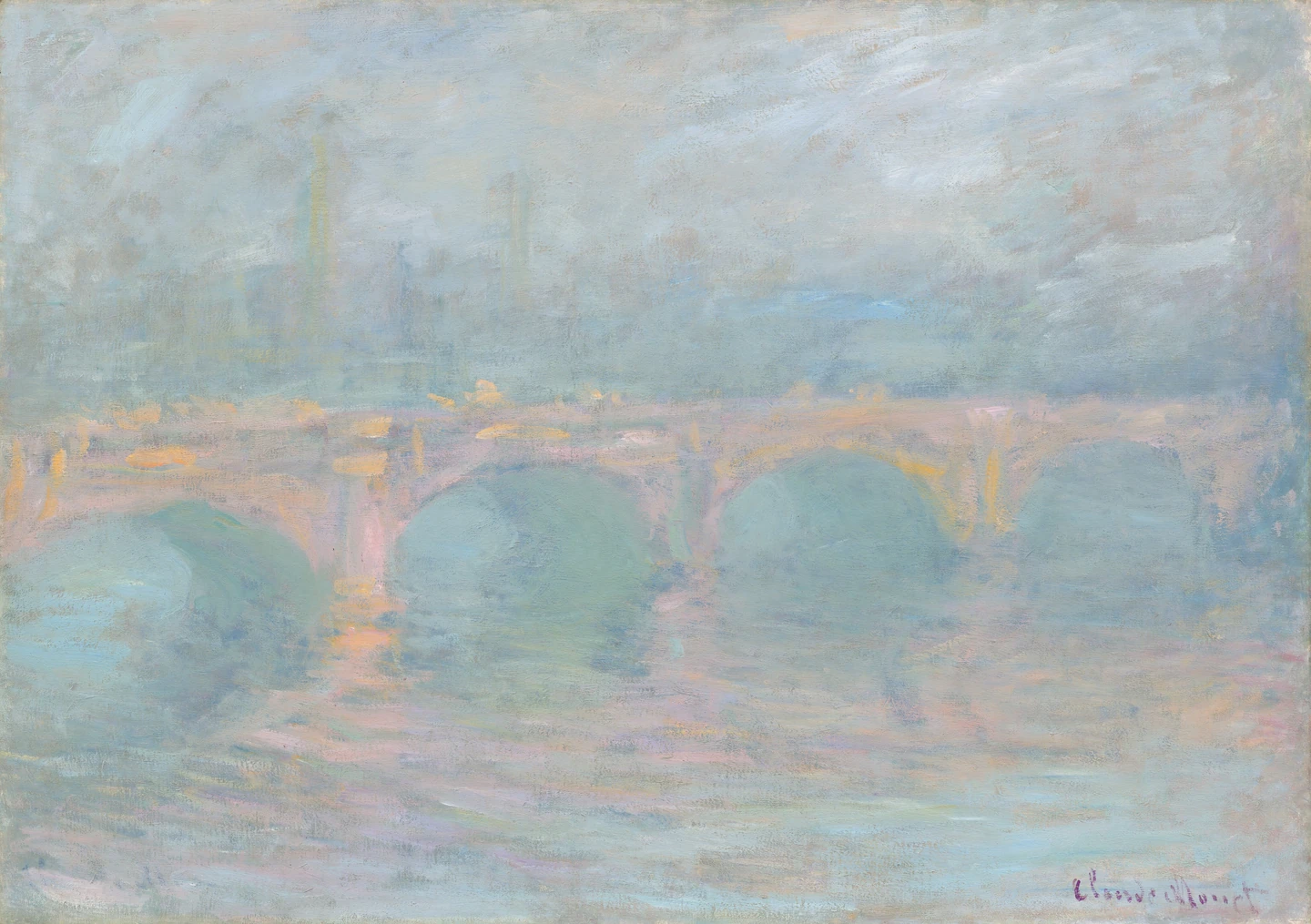
Describe a painting before assigning it a label. Is it a landscape or an interior? Are all its edges equally sharp? One passage may be clearly defined while another is abbreviated. That variation tells us more than a quick judgement that a visible brushstroke means unfinished work.
What does a brushstroke contribute?
The National Gallery describes broken or flickering brushwork as particularly effective for suggesting fleeting light. Broken does not mean a surface covered in identical dots. Marks can differ in length, direction and density, and their relationships matter as much as their individual shapes. National Gallery: Impressionist
Study a small passage, then the whole picture. Notice each mark’s direction and thickness. From farther away, do the marks gather into light, shadow or movement? This reads the image without claiming to reconstruct the painter’s exact hand movements.
Choose purposeful marks
In your own work, give a mark a purpose before adding it. A short horizontal stroke can establish a calm surface; an angled mark can interrupt that rhythm. Repeating the same mark everywhere may flatten the picture’s hierarchy, even when the individual colours are attractive. Economy requires attention, not simply speed.
An object’s named colour is only a starting point
The Met discusses colour in shadows and highlights, and carefully organised compositions beneath an apparently spontaneous surface. That is a reason to question automatic formulas: adding black to every shadow or white to every illuminated area cannot answer every observation. The Met: Impressionism, Art and Modernity
Separate three questions. How light or dark is the area? Does it seem warmer or cooler than its neighbour? Is its colour intense or muted? Different objects may share a similar value, while one object contains very different values. Comparisons help you see what is present instead of painting what the object’s name leads you to expect.
Do not replace one formula with another by declaring that shadows must always be blue or violet. Observe the particular illumination and surrounding surfaces. A digital reproduction is also a mediated view: photography and screens can affect colour. Use it to study relationships, not to identify the original pigments by eye.
Wheat stacks: a repeated subject, changing questions
The Art Institute dates Stacks of Wheat (End of Summer) to 1890–91. Its study of the series documents work both outdoors and in the studio over multiple sessions. A convincing fleeting effect does not therefore prove that a canvas was completed in a single outdoor sitting. Museum image record: Stacks of Wheat, End of Summer · Art Institute of Chicago: Stacks of Wheat scholarly catalogue
The technical examination of this painting describes accumulated paint and changes during its construction. For a learner, this offers a productive distinction: a lively surface and a carefully revised picture are compatible. Correction need not erase energy or count as failure. Art Institute of Chicago: technical study of Stacks of Wheat, End of Summer
When comparing two versions, start with one question: where is the strongest light-dark difference? Next compare the stack against the sky, then the shadow across the ground. Write a short description of each relationship. The aim is not to decide which version is correct, but to notice different pictorial solutions around a repeated subject.
An observation exercise in three small studies
Place a cup or piece of fruit near a window and keep your viewpoint fixed. Draw three equal small rectangles. In the first, reduce the scene to three values. In the second, retain that structure while adding warmer and cooler relationships. In the third, try visible marks while keeping the two largest masses clear. Use a familiar medium: this is a decision-making exercise, not a shopping list.
Step back from the studies. If the object disappears, check the main contrasts before adding detail. If the shadow seems detached, inspect its connection. Note one adjustment for another session.
This is a contemporary learning exercise inspired by looking at paintings, not a documented reconstruction of Monet’s teaching. ArtAcad’s oil-painting course can support the next stage of material practice. Check its current syllabus and lesson-language availability; do not assume that it is a specialist course in the history of Impressionism.
Frequently asked questions
Is every painting with visible brushwork Impressionist?
No. Visible marks occur across periods and styles. Consider the artist, date, subject and treatment of light. A single surface characteristic is not enough to identify a historical movement.
Were all Impressionist paintings made outdoors?
That is too broad a claim. The Art Institute documents Monet working on the wheat stacks outdoors and in the studio over multiple sessions. Outdoor painting matters, but does not explain every artist’s working method.
Can I learn from this if I only draw in pencil?
Yes. Compare values, simplify detail, and vary edges and mark density. Those observations can be practised in graphite before you introduce colour, while recognising that a monochrome study cannot reproduce the whole experience of a coloured painting.
Continue learning with the academy
Choose a course for the skill you want to develop, and check its curriculum and lesson language on the course page.
- Oil Painting — For material practice and observing light; not presented as a specialist Impressionism history curriculum.
Sources and further reading
- The Met: Impressionism, Art and Modernity
- National Gallery: Impressionist
- Art Institute of Chicago: Stacks of Wheat scholarly catalogue
- Art Institute of Chicago: technical study of Stacks of Wheat, End of Summer
- Museum image record: Stacks of Wheat, End of Summer
- National Gallery of Art, Washington: Waterloo Bridge at Sunset