What you will learn
- Distinguish the designer from the people who carved, printed and published a work.
- Study line, mass and empty space before getting lost in foam details.
- Separate an image’s design from the particular museum impression you are viewing.
Circulating pictures, not only landscapes
Ukiyo-e developed within the urban culture of Edo-period Japan and encompassed varied subjects, including actors, everyday scenes and landscapes. Woodblock printing enabled multiple impressions from a design. Colour printing expanded during the eighteenth century, so the tradition should not be imagined as one unchanging full-colour process. The Met: Woodblock Prints in the Ukiyo-e Style
Avoid treating one famous image as a summary of Japanese art. Equally, admiration should not erase the picture’s original cultural setting. A museum record provides a title, medium, approximate date and information about the particular object. That is a firmer starting point than an image circulating without identification.
Four roles behind the picture
The Library of Congress describes ukiyo-e production as collaboration among publisher, designer, carver and printer. The publisher coordinated the project and its circulation; the designer supplied the image; the carver made the blocks; the printer transferred colour to paper. A famous designer’s name does not mean that person performed every manual stage. Library of Congress: The Floating World of Ukiyo-e
Imagine a thin line at the edge of a wave or a garment. The designer gives it a purpose, the carver preserves its structure, and the printer makes it register consistently. This is more than a sequence of isolated jobs: a decision in one stage can affect what the next stage is able to achieve.
From a key block to aligned colours
The V&A explains how a key block established the lines and how proofs helped prepare colour blocks. Registration marks guided the placement of the paper between printings. Position therefore mattered alongside the quality of the drawn line. V&A: Japanese woodblock prints, ukiyo-e
Raised areas of a block transfer the image while other areas are cut away. You can explore that relationship without a blade: draw a broad black shape and decide which parts should carry ink and which should remain paper. Begin with mass and space rather than attempting delicate strands.
This is an introduction to the principle, not a complete carving lesson. Paper, pigment distribution and pressure can affect an impression’s appearance. Treat documented museum impressions as individual objects, not interchangeable copies of a digital file. Record the institution or accession number before interpreting a colour difference.
Read the large wave and the small mountain together
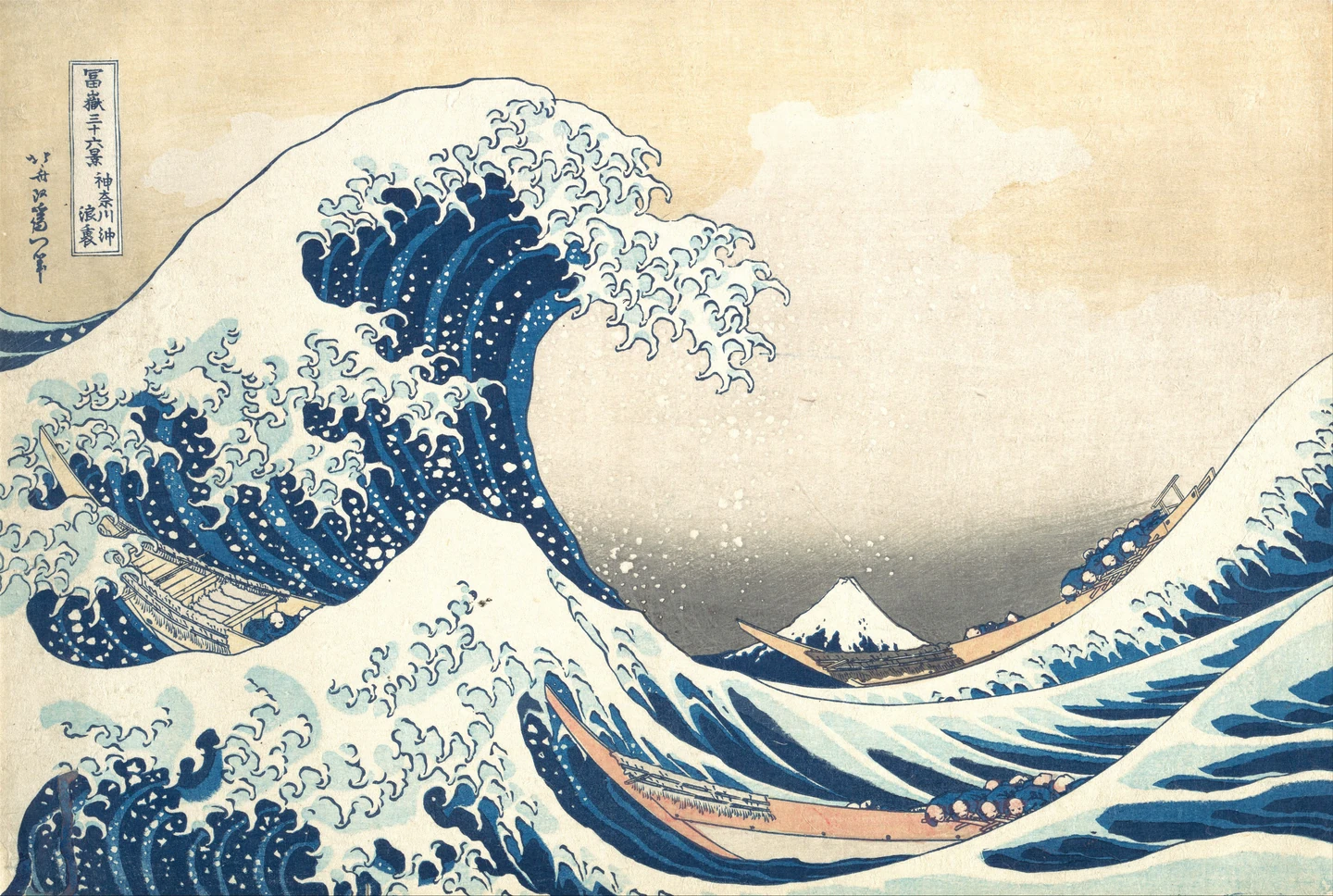
The Art Institute records Under the Wave off Kanagawa, commonly called The Great Wave, from Thirty-Six Views of Mount Fuji, dated 1830–33. It notes that its three impressions are later than the first state. The image displayed here is the Met’s impression, identified in its caption. Art Institute of Chicago: The Great Wave collection record
The Met draws attention to the small Mount Fuji within the wave’s curve and to indigo and Prussian blue in Hokusai’s landscapes. Museum date ranges may differ slightly; use the date attached to the particular illustrated record rather than implying a single certain printing day. The Met: Under the Wave off Kanagawa
Looking exercise: curve and space
For an original looking exercise, trace the large curve with your eyes and pause in the space beneath it. Locate the mountain, the long boats and the small human forms. Cover the mountain with a piece of paper: does the sense of scale change? Ignore the foam for a moment: does the main movement remain? These are viewing prompts, not claims about one definitive intention.
White actively shapes the composition. Reduce it to water, sky and smaller distant forms. Does the tension remain? Study that structural relationship before copying details.
An original line-and-space exercise, without carving
Draw two small rectangles. In the first, invent a large curve with a small shape beneath it using one dark colour. In the second, move the small shape towards an edge and redraw the curve. Compare where your attention settles. This tests proportion and placement; it is not a historical print or a reproduction of Hokusai’s authorship.
Add a second colour on tracing paper or a separate digital layer. Shift it slightly, then align it again. This gives a practical analogy for why registration matters. It is a contemporary demonstration, not an equivalent of the materials and gestures in a traditional workshop.
ArtAcad’s pencil-shading course can support observing masses and edges, while its Illustrator course may suit practice in organising shapes. These are related drawing and design skills, not claims that either course teaches traditional ukiyo-e production. Check the current syllabus and lesson language before choosing.
Frequently asked questions
Is The Great Wave one unique original painting?
It is a woodblock-print design with multiple impressions. Identify the museum impression and its collection details rather than assuming the digital image represents one unique painted object.
Did Hokusai personally carve and print every copy?
Do not infer that from attribution of the design. Traditional ukiyo-e production involved designer, carver, printer and publisher. Credit the roles documented by the record without inventing missing names.
Do I need carving tools to begin learning?
No. Start by studying line, mass and empty space, then explore two-colour alignment with paper or digital layers. Actual carving requires appropriate instruction, tools and safety practice beyond copying a published image.
Continue learning with the academy
Choose a course for the skill you want to develop, and check its curriculum and lesson language on the course page.
- Pencil Shading — For observing masses and edges; not a woodblock-printmaking course.
- Design with Adobe Illustrator — For organising shapes and layers; not a reconstruction of traditional workshop practice.