
What you will learn
- Understand the movement’s early twentieth-century context without treating its artists as identical.
- Connect material, scale and architectural setting with the experience of looking.
- Distinguish a documented historical fact from your own interpretation of an image.
What was Mexican muralism?
MoMA places the movement’s beginnings in the early 1920s, after the Mexican Revolution. Government commissions encouraged public images concerned with national history and the future. Workers, peasants and Indigenous heritage gained prominent roles. Artists used several techniques, including fresco, encaustic and mosaic; muralism was not a single material recipe. MoMA: Mexican Muralism
This context gives you questions to ask, not a shortcut to the meaning of every wall. What history is selected? Who appears as an active participant, and who is missing? How does the commissioning institution relate to the image? An artwork can address a broad public while still presenting a particular, contested view.
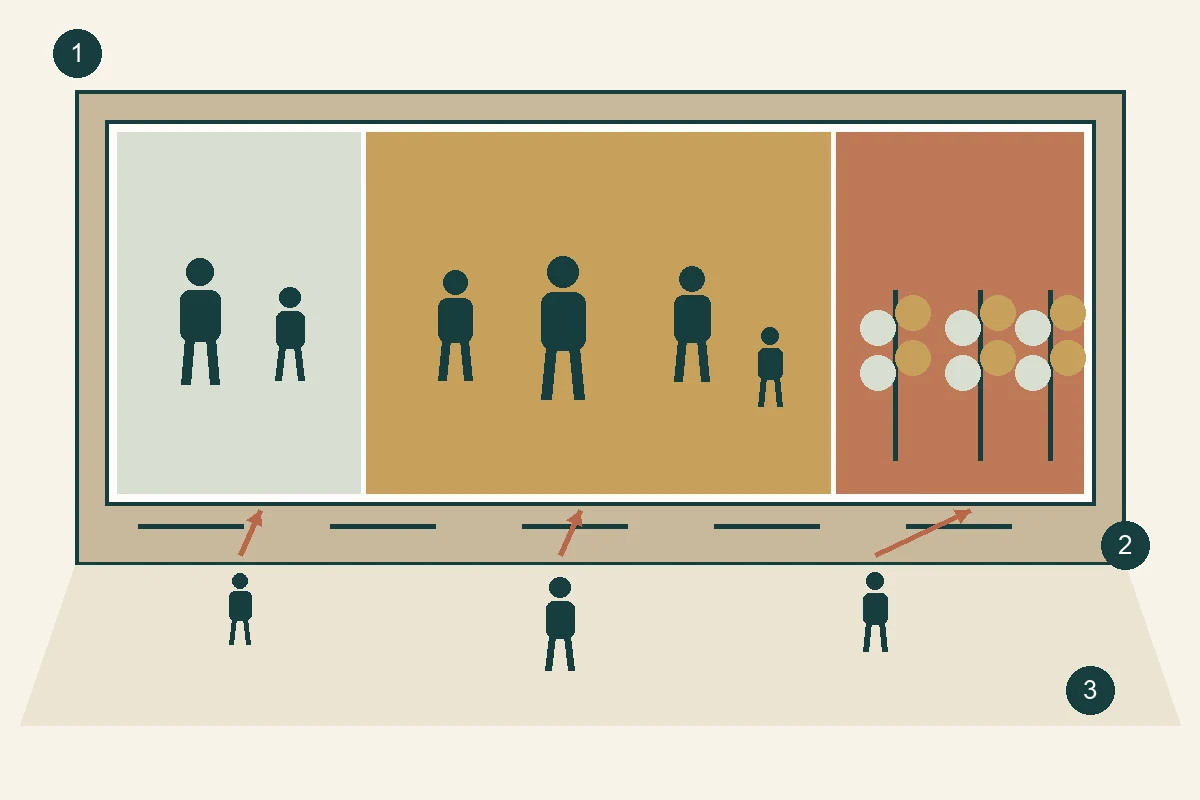
Our illustration uses an invented wall and generic figures to clarify scale, architecture and audience. It does not stand in for a historical mural. For the real works discussed below, follow the linked museum records and examine their images alongside the text. Keeping example and evidence separate is part of responsible art literacy.
Three prominent artists, different approaches
The Whitney Museum warns against treating Diego Rivera, José Clemente Orozco and David Alfaro Siqueiros as a homogeneous group. Its account contrasts Rivera’s expansive historical narratives with Orozco’s more tragic treatment of revolutionary promise. It also traces the artists’ work in the United States between 1927 and 1940 and their importance to American artists. Whitney Museum: América — Mexican Muralism and Art in the United States
These differences matter when you describe what an image does. A collective movement does not require identical politics, temperament or technique. Rather than assign each artist a fixed personality, choose one work and one visible decision: the size of a figure, the direction of a gesture or the relation between a crowd and a machine.
The familiar grouping of three leading names is a starting point, not a complete inventory of Mexican art. Use it to open further study, not to erase other contributors. The most useful comparison is specific enough that someone else can check it in the artwork and in a reliable record.
Rivera: industry surrounding the viewer
At the Detroit Institute of Arts, Rivera’s Detroit Industry murals of 1932–33 occupy all four walls of the central courtyard. The museum describes relationships among technology, labour and human ambition, including the beneficial and destructive potential of industrial development. The setting makes the work an environment rather than one isolated rectangular image. Detroit Institute of Arts: Rivera Court · Detroit Institute of Arts: Detroit Industry Murals explained
Begin with the museum’s broad view of Rivera Court before zooming into a detail. Note how much of the wall lies above a standing person, and where architectural divisions interrupt the painted field. Then select a small group and describe how bodies relate to the machinery around them.
Changing viewing distance changes the task. From far away you may follow large masses or repeated colours; closer in you can inspect a face or a hand. Record the difference in your own words. Do not infer that a painted factory is a neutral photograph of working life: ask what the composition emphasises and what the museum’s interpretation supports.
Orozco: history without a simple victory story
The Hood Museum records Orozco’s The Epic of American Civilization, painted in 1932–34, in Dartmouth’s Baker Library. Its twenty-four panels frame an account of the Americas that includes Mesoamerican civilizations and the devastation of conquest. The museum presents the cycle through recurring destruction and creation rather than uninterrupted progress. Hood Museum: Orozco’s Epic
Look at one panel, then locate its neighbours in the cycle. A dramatic fragment can seem self-contained when reproduced alone, but the surrounding sequence may complicate that impression. Write a provisional description, then revise it after seeing the wider arrangement.
Treat a historical image as a claim made through art. It may combine events, symbols and imagined figures. You can discuss the effect of a compressed group or an unsettling gesture without asserting that the scene is a literal record. Separate the depicted story, the circumstances of making the mural, and the history you would need other sources to establish.
Siqueiros and the importance of materials
MoMA records Siqueiros’s Collective Suicide of 1936 as lacquer on wood with applied sections, and relates his use of commercial and industrial materials to his public and political aims. This particular work is not a wall fresco. It shows why an artist associated with muralism cannot be understood through wall painting alone. MoMA: Siqueiros, Collective Suicide, 1936
For comparison, the Hood Museum explains true fresco as pigment applied to freshly prepared wet plaster, with the artist working in planned sections before the surface dries. The material changes the practical decisions behind the image; the word mural describes neither one universal surface nor one identical process. Hood Museum: José Clemente Orozco — Learning to Look
When you open an object record, read the medium before guessing how the work was made. A reproduction can flatten the difference between plaster, wood and canvas. You do not need to become a conservator to notice that an attached panel and an image painted into a building create different possibilities for making, moving and preserving art.
Read a mural at three scales
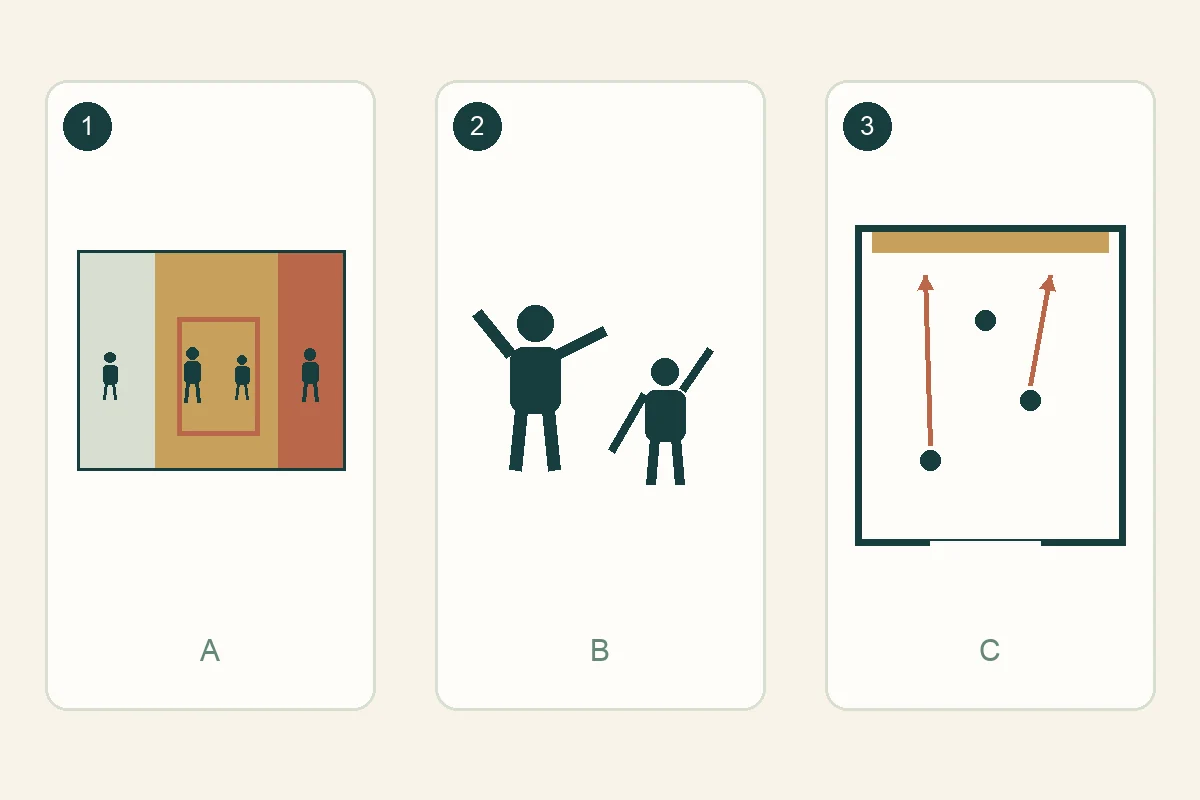
The second diagram offers a looking sequence you can use with a museum’s online overview. It is our teaching method, not a claim that every muralist intended the same route through a work.
- Whole: identify the major masses and architectural breaks. Describe where your attention begins without claiming that every viewer starts there.
- Relationship: choose two figures, or a figure and an object. Compare size, direction, gesture and spacing. Support a suggested effect with one visible detail.
- Context: check artist, title, date, medium, location and patron where documented. Return to the overview and ask what your close-up left out.
A small composition exercise, without copying a mural
Draw three wide rectangles on ordinary paper. Choose a modest subject you know directly, such as neighbours preparing a shared garden. In the first rectangle, give every element similar weight. In the second, make one action dominant. In the third, organise two related actions across separate areas. Use simple shapes instead of detailed portraits.
Place the three sketches at arm’s length. Which reads most clearly, and what does that clarity leave out? Add a one-sentence note naming the audience you imagined. This is practice in composition and responsibility, not a reconstruction of Mexican history or permission to paint on a public wall.
Return to the museum examples after this exercise. You may notice choices of scale, emphasis and sequence that escaped you at first. The reward of studying muralism is not a formula for making every picture monumental: it is greater attention to how images enter shared spaces and whose stories they ask us to consider.
Frequently asked questions
Is every large wall painting Mexican muralism?
No. Mexican muralism refers to a particular historical movement and its context. Large wall paintings exist in many times, places and traditions.
Were all works by the muralists painted in fresco?
No. They worked in different techniques and formats. Check the medium of each work; Siqueiros’s Collective Suicide is lacquer on wood with applied sections.
Continue learning with the academy
Choose a course for the skill you want to develop, and check its curriculum and lesson language on the course page.
- Oil Painting — For your own small studies in colour and composition, explore the oil-painting course. It does not teach the historical fresco process described here or replace a specialist course in Mexican art history.
Sources and further reading
- MoMA: Mexican Muralism
- Whitney Museum: América — Mexican Muralism and Art in the United States
- Detroit Institute of Arts: Rivera Court
- Detroit Institute of Arts: Detroit Industry Murals explained
- Hood Museum: Orozco’s Epic
- MoMA: Siqueiros, Collective Suicide, 1936
- Hood Museum: José Clemente Orozco — Learning to Look