
What you will learn
- Find a horizon and a family of receding lines without treating every diagonal alike.
- Place Brunelleschi and Alberti in the history of a particular system of representation.
- Compare geometric depth with overlap, tone and the subject of a painting.
A system developed in Renaissance Florence
The National Gallery associates single-point linear perspective with Filippo Brunelleschi in Florence and its use by artists in the early fifteenth century. Leon Battista Alberti codified the system in his treatise On Painting, or De Pictura. This describes an important development in Renaissance representation, rather than the beginning of all attempts to suggest depth. National Gallery: Perspective
The Gallery dates De Pictura to 1435. Its glossary distinguishes linear perspective, which primarily uses lines, from aerial perspective, which primarily uses tone and colour. Keeping those terms separate helps you identify the actual evidence in a picture. National Gallery: Linear perspective
When you read a history of technique, watch the verbs. Demonstrating a method, describing it in writing and using it in a particular painting are different activities. Avoid reducing a broad period to one inventor, one year or a single visual formula. A useful question is what this system allowed a painter to organise, not whether every earlier image was somehow inadequate.
What do horizon and vanishing point mean?
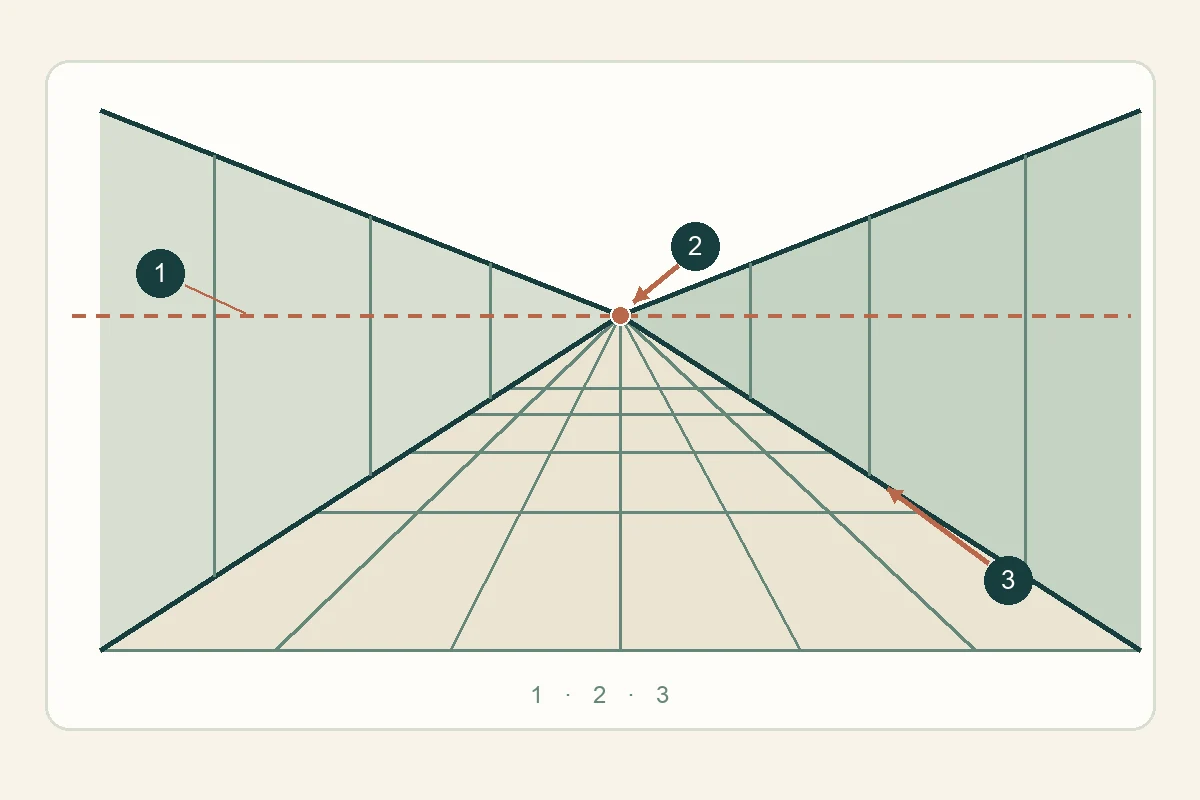
In our level-view corridor diagram, the dashed horizontal line marks the viewer’s eye level. The orange dot is the vanishing point for the corridor edges running directly away from that viewer. The left and right walls do not literally meet there; their drawn edges converge as an effect of projection onto a flat surface.
The National Gallery’s teaching resource explains how receding parallel lines can be constructed to meet at a vanishing point. Begin with one set of edges sharing the same direction in the imagined space. Do not extend every diagonal you see and expect all of them to arrive at that same point. National Gallery: Cross-curricular ideas — Mathematics
A sloping roof, a raised arm and a road edge may point in different directions for different reasons. Likewise, the horizon need not be a visible border between land and sky: an interior can have an eye level even when no sky appears. Use the diagram as a clear starting case, then check which assumptions still fit the painting you are studying.
Uccello: a battle arranged through lines
The National Gallery dates Paolo Uccello’s The Battle of San Romano to probably about 1438–40. Its account identifies broken lances laid out like a grid in the foreground and pieces of armour seen at different angles. It also notes that the receding lines are interrupted by the hedge. National Gallery: Uccello, The Battle of San Romano
Open the museum image and temporarily ignore the busy group of horses. Choose three lance fragments on the ground. Sketch their directions in a small rectangle, then mark the hedge. Does your eye move continuously into deep space, or does it meet a visual stopping place? This is a looking prompt, not a reconstruction of Uccello’s complete working method.
Next return the figures to your attention. Ask how the ground arrangement relates to their clustering and movement. A painting can organise space and still feel crowded, decorative or theatrical. Geometry is one decision among many; identifying it should make the scene more interesting, not turn it into an exam in which you hunt for mistakes.
Crivelli: a vanishing point away from the centre
Carlo Crivelli’s The Annunciation, with Saint Emidius is dated 1486. The National Gallery explains that its vanishing point sits to the left of the composition, allowing a view down the street beside a close view into Mary’s house. The spatial arrangement serves the scene rather than obeying a requirement to place everything centrally. National Gallery: Crivelli, The Annunciation, with Saint Emidius
Compare the street with the richly decorated building front. Follow one architectural edge into the distance, then look for a detail that holds your attention near the surface. Notice your change of focus. Write “my eye moves between the street and the decorated façade” if that describes your experience; do not present your response as the only possible reading.
The museum’s object page is the reference for the work’s title, date and subject. Our diagrams are modern explanations, not tracings from this painting. Keeping those roles distinct lets you learn from a simplified example without mistaking it for evidence about the original artwork.
Depth is more than converging lines
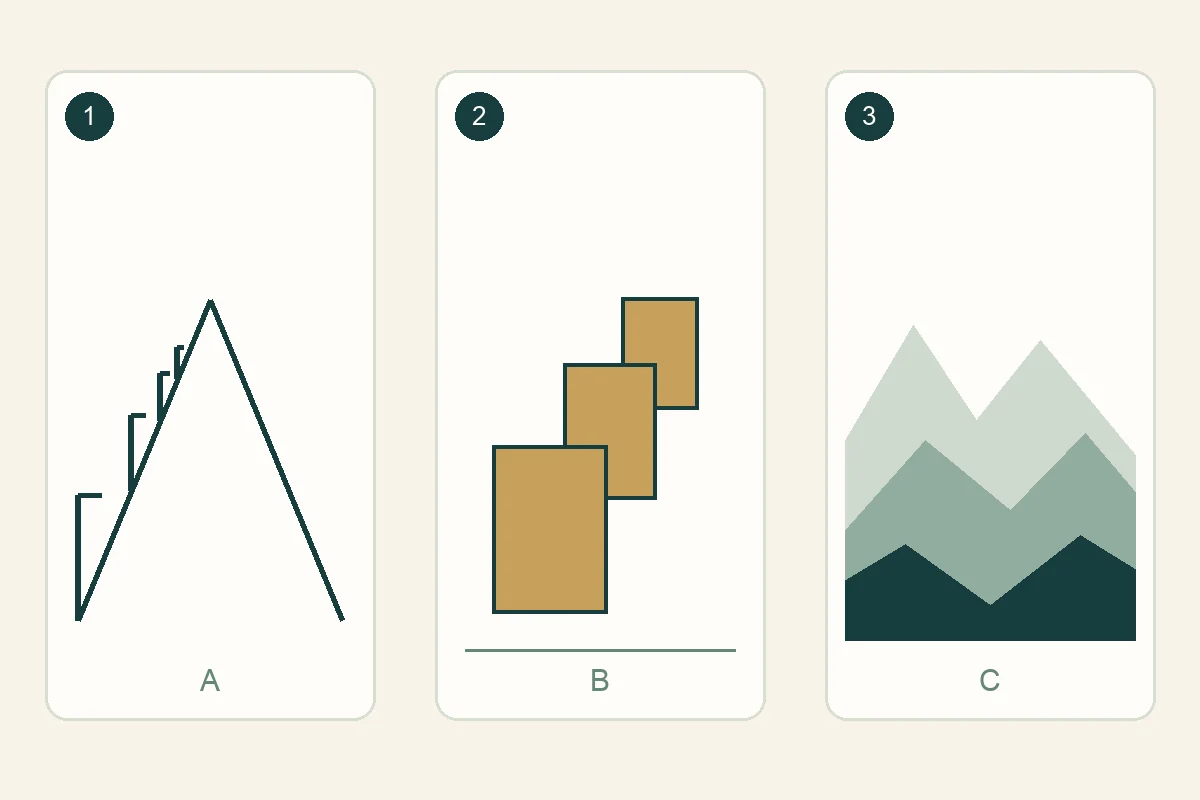
The second illustration separates three cues. In A, edges converge while repeated upright forms diminish. In B, one shape hides part of another. In C, contrast becomes weaker across the more distant mountain bands. None of these panels is a complete landscape or a recipe that every artist must follow; they isolate relationships so that you can recognise them more easily.
The National Gallery’s Building the Picture research stresses that perspective was a tool, not the sole purpose of Italian architectural painting. Artists could reinterpret its rules, and architecture could carry sacred, civic or other meanings. A persuasive account therefore considers subject and setting as well as recession. National Gallery: Putting perspective into perspective
Try covering the distant half of a reproduction with a sheet of paper. Which cues remain near the foreground? Then reverse the cover. This small comparison can reveal whether the depth you noticed depends mainly on overlap, scale, lines or differences in colour. It also prevents a single technical term from replacing close observation.
A fifteen-minute exercise for your next museum image
You need paper, a pencil and one museum reproduction. Work on your own thumbnail instead of drawing over the original. The aim is to test an observation, not to claim a precise measurement from a small photograph.
- Spend three minutes looking without a ruler. Write down where the picture feels near, far or ambiguous.
- In a small rectangle, draw three edges that appear parallel in the represented space. Extend them lightly. Record whether they meet convincingly, roughly or not at all.
- Mark a possible eye level only if the evidence supports it. Separate it from the outline of hills or buildings.
- Add one non-linear depth cue and one detail connected with the subject. Read the museum record, then revise one sentence of your interpretation.
How to judge your result
A successful study names the evidence and its limits. “These three floor edges suggest a point near the left side” is stronger than “all Renaissance paintings use one point.” If the edges do not line up, check whether you selected different directions before deciding that the artist made an error.
Keep the thumbnail beside a short note containing the artist, title and date. On a second visit, compare your first impression with the painting’s larger arrangement. Learning perspective becomes most useful when it improves what you notice: a threshold, an interruption, a deliberate shift in scale, or a passage where the subject asks you to look beyond the geometry.
Frequently asked questions
Must the vanishing point be in the centre?
No. Crivelli’s Annunciation provides a documented example with the vanishing point to the left. Its position is part of the composition.
Is the horizon always the line between the sky and land?
No. In the level-view example it represents eye level. An interior can have a horizon in the perspective construction even without a visible sky.
Continue learning with the academy
Choose a course for the skill you want to develop, and check its curriculum and lesson language on the course page.
- Pencil Shading — For practice with light, dark and the appearance of volume, explore the pencil course. It is a drawing course, not a specialist history of Renaissance perspective; check its curriculum and lesson language.